DAN SHUMAKER COLLECTION
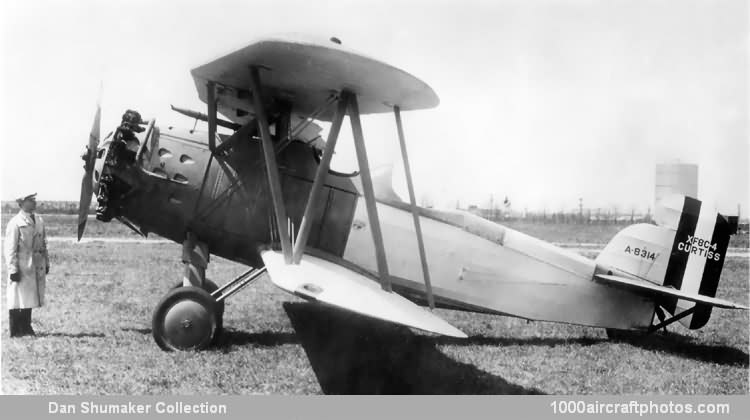
No. 9131. Curtiss 49A XF8C-4 Helldiver (A-8314) US Navy
Photograph from Curtiss, via Robert C. Mosher & Hudek Aero Collections
APS No. 2062

Curtiss 49A XF8C-4 Helldiver


Created July 31, 2009
Other than the Hawks and Falcons, the principal Curtiss military production model of the late 1920 period was the two-seat fighter-bomber known as the Helldiver. Although this was the first production Navy aircraft designed specifically for dive-bombing, it was originally given the fighter designation XFSC-2, which gave the impression that it was a variant of the FSC-1 Falcon when it was actually an entirely new design. Production versions served briefly in the fighter role but were soon withdrawn from the fleet and assigned to Naval Reserve units, where they stayed to the mid-1930s. Some F8C-5s on order were completed as O2C-l observation models while others were ordered as observation aircraft. An attempt to prolong the production life of the basic model by detail refinement and the installation of more powerful engines in later prototypes was not successful. XF8C-2 (Model 49)-The Helldiver prototype was the third aeroplane on a $73,008 (less GFE) Navy contract for three experimental two-seat fighters. The first two were Naval versions of the Army's XA-4 Falcon ordered as XF8C-l, while the third was an entirely new design ordered as XF8C-2 and identified by Curtiss as L-117-1. Built at Garden City, the XF8C-2 clearly showed its origins in the Falcon line combined with details of the F7C- l. A unique feature, inspired by the Vought O2U Corsair and the XF7C- l, was the use of main fuel tanks built into each side of the fuselage alongside the front cockpit. Fuselage structure was welded steel tube, wings were wooden framed and the tail surfaces were aluminium framed. Armament consisted of two forward-firing · 30 calibre machine-guns in the centre section of the upper wing outboard of the propeller arc, two flexible guns on a Scarff ring around the rear cockpit, plus underwing bomb racks. Powerplant was the same 450 hp Pratt & Whitney R-1340 Wasp used in the F8C-1/OC-l Falcon and the F6C-4 Hawk. The original XF8C-2, which first flew in November 1928, was lost on a maker's test flight on 3 December, 1928. It was replaced without cost to the Navy by a duplicate carrying the same Navy serial number, A 7673, in August 1929. XF8C-4 (Model 49A)-A second Helldiver prototype, delivered in April 1929, was designated XF8C-4. The principal outward difference from the XF8C-2 was a cutout at the bottom of the rudder to accommodate a new and relocated oleopneumatic tailskid assembly. Navy serial number was A8314 and cost less GFE was $61,894. F8C-4 (Model 49B)- Twenty-five production versions of the XF8C-4 were built at Buffalo, early examples going into service with VF-1 B aboard the uss Saratoga in 1930. Although not fitted with engine ring cowlings when delivered, many F8C-4s were so equipped in later years. Unit cost $15,450 less GFE, Navy serial numbers A8421/8445. FSC-4 Two-seat fighter/dive-bomber. 450 hp Pratt & Whitney R-1340-88. Span 32 ft (9· 75 m); length 25 ft 11 ¾ in (7·92 m); height I Oft 2 in (3·09 m); wing area 308 sq ft (28·61 sq m). Empty weight 2,506 lb (1,137 kg); gross weight 3,776 lb (1,713 kg) fighter, 4,038 lb (1,832 kg) bomber. Maximum speed 137 mph (220·47 km/h); cruising speed 116 mph (186·68 km/h) at 6,000 ft (I ,829 m); climb 1,030 ft/min (5·23 m/sec); service ceiling 19,800 ft (6,035 m); range 452 miles (727 km) at 6,000 ft (1,829 m). Armament-four ·30-in machine-guns, 500 lb (226 kg) bombs.