Both Chief-Designer Frank S. Barnwell and Chief-Engineer A.H. Roy Fedden agreed with Fairey's view that in actual warfare, performance was all-important and that much of the equipment would be jettisoned by squadrons in their efforts to squeeze out the ultimate advantage in speed. By November 1925 Fedden was convinced that the Air Council had taken the point and in only a short time would swing over to high-speed lightly equipped machines; he feared that when this happened all the orders would go to those with liquid-cooled engines of low frontal area, unless the radial engine's capabilities were demonstrated anew.
Fedden was developing a long-life military version of the Mercury engine, and Barnwell considered that a biplane with this engine could be designed to carry the same load as the Fox at 160 mph. The Directors agreed to a design being detailed as a private venture in the hope that the Air Ministry might order a prototype; the designer would be free from official interference and there was quite a possibility that as a two-seater fighter the machine might find a market abroad.
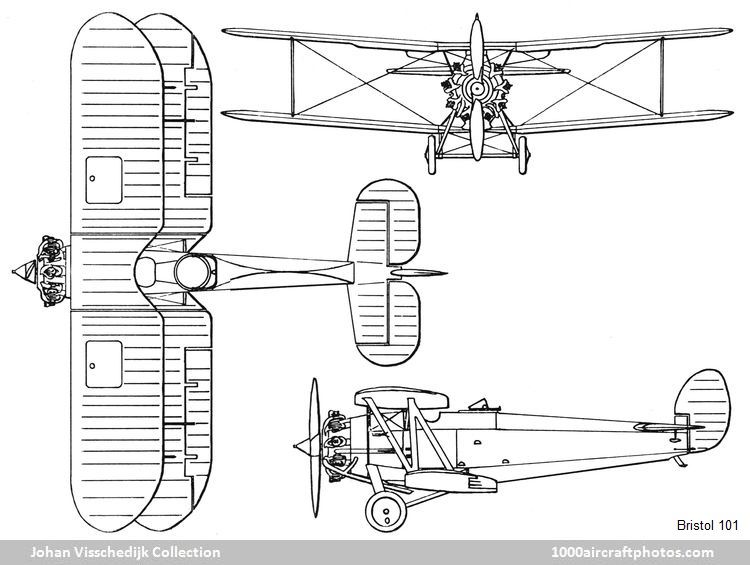
In January 1926 Barnwell submitted the general arrangement of the new project, Type 101, equipped as a fighter with two front guns, a twin-gun Scarff ring for the rear gunner, 1,200 rounds of ammunition, 84 gal (318 l) of fuel, parachutes and oxygen, but no wireless, camera or bomb gear. It had steel wings and tail unit, combined with a plywood monocoque fuselage of great strength, and was expected to reach 160 mph with a 480 hp Mercury.
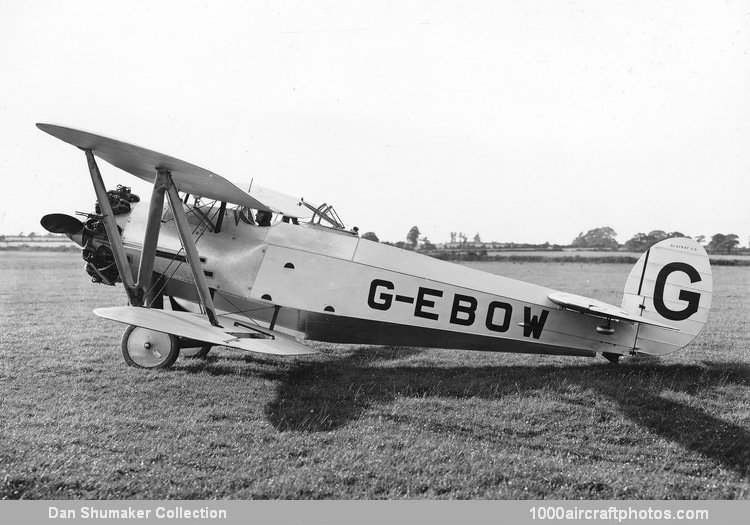
The design was submitted to the Air Ministry in March 1926, but turned down categorically because of its use of wood, so work on it was stopped soon after the prototype had been registered G-EBOW (c/n 7019) on July 17, 1926. However, in October, interest on the 101 was revived by an enquiry for a high-speed survey aircraft to carry a Williamson Eagle camera, and it was decided to complete one prototype as a private venture, both to demonstrate the Jupiter and Mercury engines and to share their development flying with the Badminton and Bloodhound.
Early in 1927 an International Aero Show to be held at Copenhagen in August was announced and this offered a favorable opportunity to exhibit the 101, in view of the widespread use of plywood construction in Scandinavia and Baltic countries; steel strip construction had been welcomed by Sweden, where the world's best iron ore was an established export, so the 101 was expected to attract attention as a suitable all-purpose fighter for countries with limited budgets. The prototype, with a 450 hp Bristol Jupiter VI engine, was completed at Filton on 27 July 1927, over a year after its registration. The first flight was made by Chief Test Pilot Cyril Frank Uwins on August 8, and the 101 was then prepared for exhibition and dispatched to Copenhagen on 27 August. There it was examined with interest by King Christian of Denmark and in any other visitors, but no sales resulted; some months later an enquiry came from Chile, but once again the credit terms requested were unacceptable.
However, G-EBOW was kept fully occupied at Filton, having replaced the Badminton as a test-bed aircraft. It was flown with the Scarff ring and guns removed during the winter, and in April it was decided to incorporate certain drag-reducing modifications and if satisfactory to enter it in the 1928 King's Cup Race. The rear cockpit was faired in, leaving only a small opening, the landing gear and wing strut fairings were increased in chord and the ailerons were repositioned on the upper wings instead of the lower. A Jupiter VIA engine was installed for the King's Cup Race on July 21, when Uwins, with Arthur Suddes as passenger, flew round the two-days' circuit of Britain into second place, only 3 min 45 sec behind the winner, at an average speed of 159.9 mph (257.3 kmh). He would certainly have won had his compass not failed early on the first day, compelling him to rely on landmarks.
After the race, G-EBOW was further modified, with new ailerons and a new engine mounting, and became a Company hack, test-bed and demonstrator for the 485 hp Bristol Mercury II engine for over a year. While diving steeply in an overspeed test with this engine on 29 November 1929, a fitting in the center section failed and the 101 broke up in the air, the pilot, C.R.L. Shaw, escaping by parachute. Ironically the failure occurred in a steel fitting and not in the plywood structure which the Air Ministry had refused to entertain, in spite of its being derived from birch veneer of which plentiful supplies were available. Apart from the specialized High Altitude Monoplane of 1934, the sole 101 was the last wooden aircraft constructed at Filton."
Span: 33 ft 7 in (10.24 m)
Length: 27 ft 4 in (8.33 m)
Height: 9 ft 6 in (2.90 m)
Wing area: 360 sq.ft (33.45 sq.m)
Empty weight: 2,100 lb (953 kg)
Loaded weight: 3,540 lb (1,606 kg)
Max speed: 160 mph (258 kmh) (fully equiped)
Max speed: 170 mph (274 kmh) (racing)
Service ceiling: 21,000 ft (6,401 m)