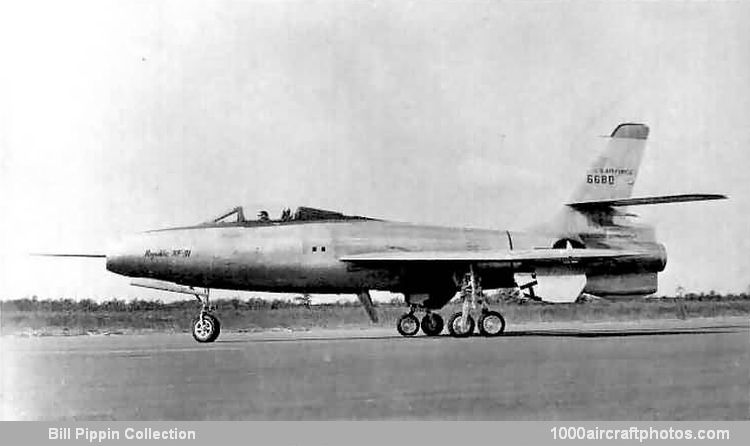
09/30/2008. Remarks by Johan Visschedijk: "Nicknamed "Thunderceptor", two of these high-speed experimental interceptors were built, s/n 46-680 and 46-681 and the first was flown by Republic Chief Test Pilot Carl Bellinger on May 9, 1949. The rocket-assisted aircraft also featured inverse tapered wings that embodied variable incidence. The wing roots were too thin to receive the landing gear, hence the aircraft had an unusual landing gear that retracted outwards towards the wing tips and required wheel well doors that hinged near the tips.
The second prototype was severely damaged in the summer of 1951, when an engine-fire on take off burned the tail section to ashes. The aircraft was rebuilt with a 'Vee' or 'butterfly' tail section, test flights from late 1952 on demonstrated drag reduction and subsequent speed increase as well as improvement to resistance of stall. After these tests the aircraft was used for crash-crew training at Edwards AFB, California, USA, and was eventually scrapped.
The first prototype was the first US combat-type aircraft to fly faster than the speed of sound in level flight on December 9, 1952, using the combined thrust of its 5,300 lb (2,404 kg) st General Electric GE J47-GE-3 turbojet and the 6,000 lb (2,722kg) Reaction Motors XLR-11 rocket, reaching a top speed of 984 mph (1,584 kmh). Eventually the aircraft was fitted with an F-86D type nose with radar radome and chin inlet.
In May 1955, 46-680 was transferred to the AF Museum at Wright-Patterson AFB, Dayton, Ohio, where it was pictured with on the tail the incorrect code 6681 (s/n 46-681) of the second prototype. With corrected markings it still is on display, presently in the Research & Development Gallery."