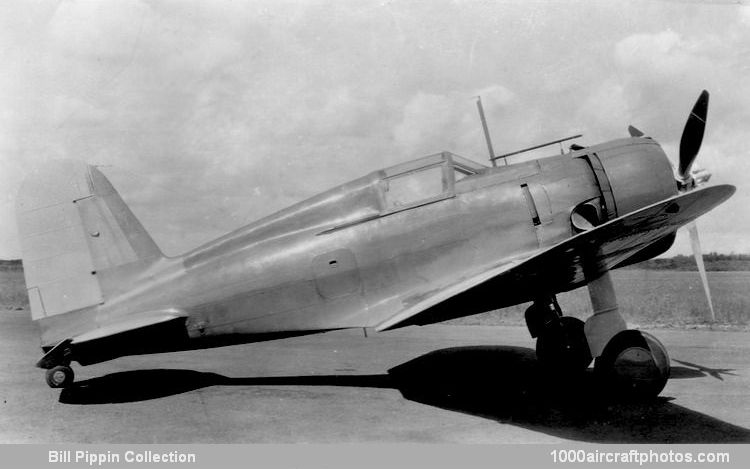
09/30/2014. Remarks by Johan Visschedijk: "When Northrop decided to abandon further development of the Model 3A, E.E. Wilson, president of Chance Vought Aircraft, arranged to purchase the project from Northrop and build a further prototype to enter in the USAAC contest. In a remarkably short space of time the new prototype was built as the V-141, this being flown for the first time on March 29, 1936 by Paul S. Baker.
Like the Northrop-built prototype, the V-141 was fitted with an 825 hp Pratt & Whitney SB4G Twin Wasp Junior fourteen-cylinder two-row radial engine, but the engine cowling was redesigned, the main wheel retraction system was revised, and, most important, the rudder was enlarged in an attempt to eradicate shortcomings in directional control and spin characteristics that had been revealed by earlier Northrop testing. The V-141 had provision for an armament of two 0.30 in (7.62 mm) Colt-Browning machine guns The V-141 failed to attract USAAC orders, being bested by both the Seversky and Curtiss-Wright contenders.
Despite the lack of success of the V-141 during the Wright Field contest, Chance Vought decided to solicit export orders for the fighter. The vertical tail surfaces were enlarged and redesigned, and, as the V-143 (registered NR56V), the prototype was shipped to Argentina for demonstration to the Argentine Army. Owing to continued dissatisfaction with the spinning characteristics of the fighter, provision was made for a spin chute, this being pointed out to the Argentine Army representatives by the Curtiss-Wright team demonstrating the competitive Hawk 75 fighter.
The Argentine Army insisted that the spinning capabilities of the V-143 be demonstrated without the spin chute being fitted. Although Edmund T. Allen, who had been hired to fly the V-143 in Argentina, was willing to undertake this demonstration, permission was refused by the manufacturer, the V-143 was shipped back to the USA, and Hawk 75 won the Argentine Army order.
The V-143 was subsequently evaluated by representatives of the Turkish air arm, but no order was placed, and shortly after this Chance Vought redesigned both the vertical and horizontal tail surfaces, simultaneously lengthening the rear fuselage by 38 in (0.97 m), increasing overall length from 22 ft 10 in (6.96 m) to 26 ft 0 in (7.93 m), and moving the horizontal tail surfaces further aft.
These changes, which markedly improved the spinning characteristics, had been introduced by the time the Japanese Army purchased the prototype in 1937, the V-143 being shipped to Japan in July of that year. Designated AXV-1 by the Japanese Army, the V-143 was tested in competition with the Nakajima Ki-27 but was found to be inferior in most respects to the indigenous fighter. Although it was later to be widely alleged that the Mitsubishi A6M Zero-Sen was based on the V-143, there was no truth in such allegations, although Vought's method of landing gear retraction provided the inspiration for that of the Japanese fighter."