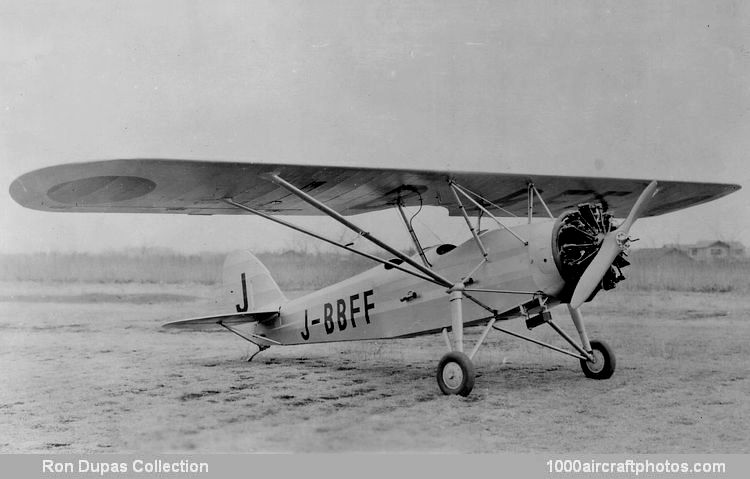
05/15/2022. Remarks by Johan Visschedijk: "By 1938, Tachikawa was already heavily involved in production of its very successful Army Type 95-1 and Type 95-3 biplane trainers. As a separate project it developed a parasol-monoplane trainer for use by civil flying schools. This was to be the first monoplane pilot trainer in Japan, and the experience gained by Tachikawa's R-series trainers was incorporated into this new design. It owed much to the Fairchild 22 which had been imported by Okura Shoji (Okura & Co Ltd, a trading company) from the United States and assembled by Tachikawa before the name was changed from Ishikawajima. This new aircraft was the R-38, a major jump in R-series numbering, the 38 referring to 1938, the year of its design development. Supervising the project was Moriyuki Nakagawa, and Chief-Designer was Ryokichi Endo.
The aircraft made its first flight on February 22, 1939, carrying the registration J-BBFE, although the photoshows that at some time it had J-BBFF on the fuselage. The 160 hp Jimpu 6 seven-cylinder air-cooled radial engine, driving a two-bladed wooden propeller, was identical to that being used in the Army Type 95-3, but the R-38 was lighter in weight and therefore superior to the Type 95-3 in speed, climb and maneuverability. When evaluated by the Army Air Technical Research Institute and the Aviation Bureau Central Pilot Training School, they agreed that the R-38 was superior. But by that time the Army had quantities of the Type 95-1 and 95-3 trainers and concluded that there was no requirement for the R-38.
Earlier, in September 1937, Tachikawa had merged with Kosokudo Kikan KK (High Speed Engine Co. Ltd.) and had planned to develop and manufacture the 120 hp KO-4 four-cylinder air-cooled inverted in-line engine to be manufactured by Kosokudo Kikan KK. There were years of delay in developing and producing the first of these engines but eventually one was available and a 130 hp Kosoku KO-4 four-cylinder air-cooled inverted in-line engine, driving a two-bladed wooden propeller, was installed in the second prototype of the R-38, greatly enhancing the aircraft's lines. Known as the R-38 Kai Trainer, and registered J-ALTB, it made its first flight in July 1941. As a result of the tighter control that the military was gaining over aircraft and engine manufacturing, the Army directed that the R-38 Kai would not be produced, and manufacture of the KO engine was to be suspended because there was no military application for it.
With the Army's rejection of this aircraft, a market failed to develop, so this one example was experimentally used by the Aviation Bureau's Matsudo Central Pilot Training School."