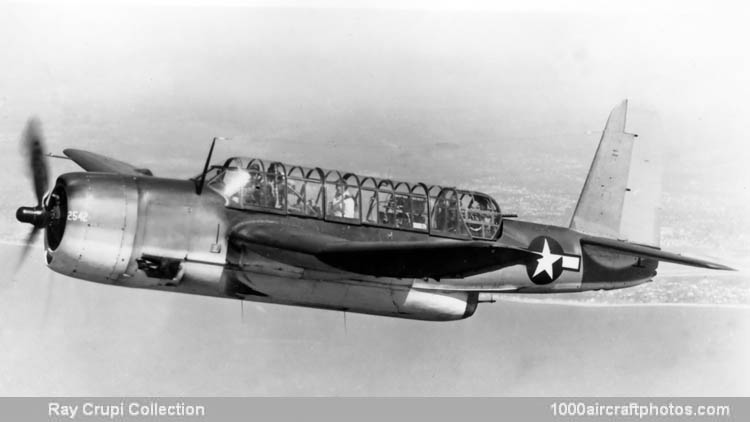
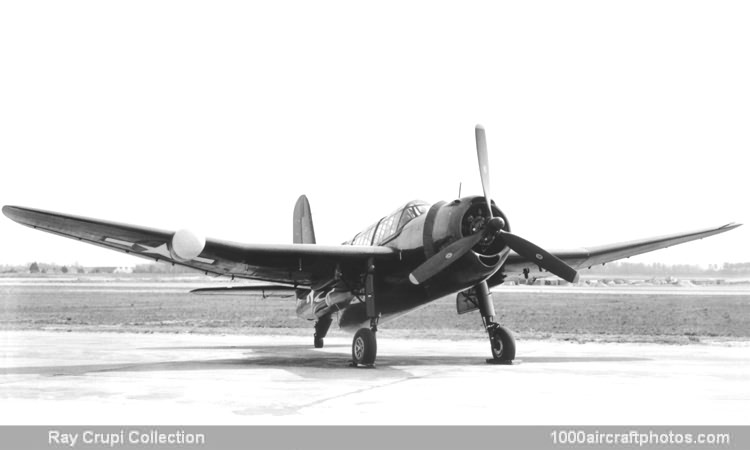
08/31/2010. Remarks by Johan Visschedijk: "The request by the Bureau of Aeronautics in 1939 for proposals on a new torpedo-bomber resulted in no less than thirteen design proposals from the industry, including Grumman, Brewster, Douglas, Hall, Vought and Vultee. In April 1940, the USN awarded contracts to Grumman and Vought for the XTBF-1 and XTBU-1 respectively, and the Vought design first flew two weeks after Pearl Harbor.
Powered by the 1,850 hp Pratt & Whitney R-2800-20 Double Wasp eighteen-cylinder two-row air-cooled radial engine, the aircraft could carry up to 2,000 lb (907 kg) of bombs or one torpedo. Defensive armament consisted of four 0.50 in (12.7 mm) machine guns (one in the engine cowling, two in the wings, one in the dorsal turret), and a single 0.30 cal (7.62 mm) machine gun in the ventral mount.
During an arrested landing test at NAS Anacostia, Washington, District of Columbia, in 1942, the hook caught and tore the whole rear end off the airplane. The airplane was repaired in four weeks, however, while being pushed out, a Navy cadet who was taxiing in the same area lost control of his aircraft and plowed into the tail of the XTBU-1. Rebuilt again, the prototype was finally accepted by the USN, and the aircraft was ordered into production in September 1943.