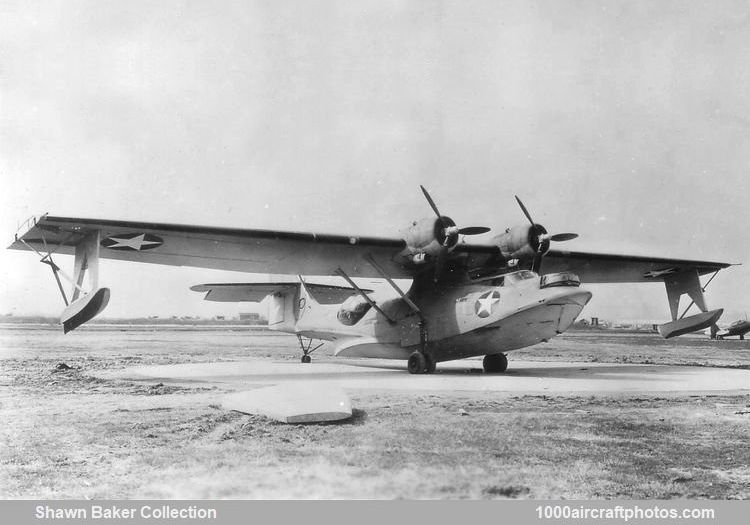
02/08/2026. Remarks by Johan Visschedijk: "In an effort to improve the handling qualities of the Catalina, the USN proposed a list of changes that if adopted would have caused considerable delays on the existing production lines. Therefore, an order placed in 1941 for 156 of the revised aircraft, designated PBN-1 Nomad (BuNo. 02791 to 02946), was given to the Naval Aircraft Factory, Philadelphia at Philadelphia, Pennsylvania.
The PBN-1 had an extended bow and hull afterbody with a small breaker step forward of the tail, revised wingtip floats, additional fuel capacity in a strengthened wing, a taller tail, and the operating weights went up. A 0.50 in (12.7 mm) gun replaced the smaller caliber weapon in the nose.
Deliveries began in February 1943, only eighteen were delivered to the USN, the remaining 138 were allotted to the USSR under lend-lease.
The aircraft for the USSR were inspected and accepted by the Soviets at NAS Elizabeth City, North Carolina. Aircraft destined for the Soviet Northern fleet were ferried via Gander, Newfoundland to Reykjavík, Iceland by the Soviets with a Royal Air Force pilot and radio operator, then onwards to Guba Gryaznaya, Murmansk, USSR with just the Soviet crew.
Aircraft destined for the Soviet Pacific fleet were ferried by USN crews to NAS Kodiak, Alaska, from where they were flown by Soviet crews to the Far East.
Aircraft destined for the Black Sea and Baltic fleets were ferried via the South Atlantic route through Brazil and Africa by the Soviets with a RAF/RCAF pilot, navigator/radio operator and mechanic as far as Habbabiya, Iraq, then onwards to Baku, Azerbaijan and Sevastopol, Russia with just the Soviet crew.
Reportedly the last production example (BuNo. 02946), also allotted as the last lend-lease example for the USSR, was damaged by fire on the production line on December 31, 1944. It was replaced by BuNo. 02802, an earlier built USN PBN-1, which was re-numbered as BuNo. 02946 to make the Soviets think that they received a 'new' aircraft."