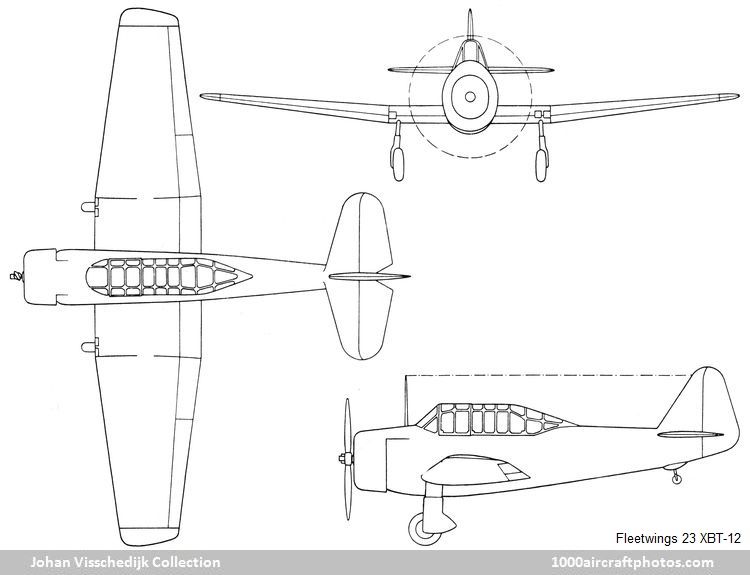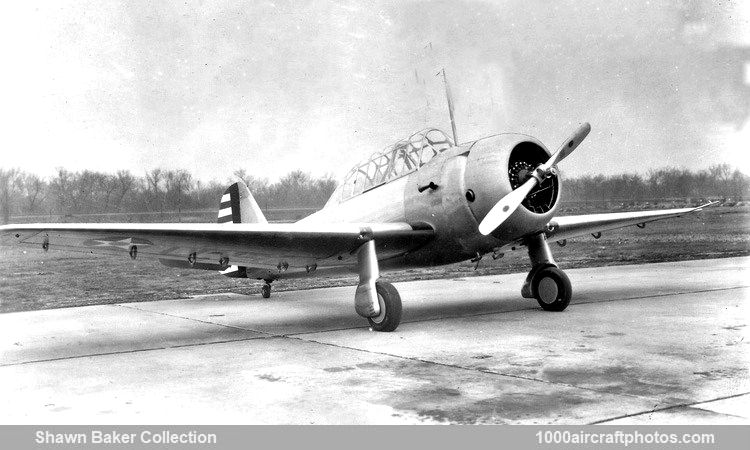
The XBT-12 was withdrawn from service and coded CL-26 it was diverted to ground maintenance training."
Wings: Low-wing cantilever monoplane. Wing section NACA 23016 tapering to NACA 4408. Structure entirely of spot and seam welded stainless steel including the covering of the first 35% of wing. The remaining portion, including the slotted flaps and ailerons, covered with fabric. Removable wing-tips.
Fuselage: Entirely of spot and seam welded stainless steel, structure consists of a built-up tubular framework with monocoque top and bottom decks aft of the cockpits. Covered with removable panels forward and with fabric on the sides aft.
Tail unit: Cantilever monoplane type. Stainless steel framework with stainless steel sheet covering on fixed surfaces and fabric on the movable surfaces.
Landing gear: Fixed cantilever type. Cleveland oleo-pneumatic shock-absorbers. Hydraulic wheel-brakes.
Power plant: One Pratt & Whitney Wasp-Junior R-985-25 nine-cylinder air-cooled radial engine rated at 450 hp at 2,300 rpm at sea level. Hamilton-Standard controllable-pitch airscrew. Fuel capacity 120 gal (454.3 l). Oil capacity 13 gal (49.2 l).
Accommodation: Tandem cockpits with dual controls under continuous transparent hooding with sliding covers over each seat. Full standard instruments and equipment for Basic Trainer classification.
Span: 40 ft 0 in (12.20 m)
Length: 29 ft 2 in (8.89 m)
Height: 8 ft 8 in (2.64 m)
Wing area: 240.42 sq.ft (22.34 sq.m)
Empty weight: 3,173 lb (1,439 kg)
Loaded weight: 4,410 lb (2,000 kg)
Max speed: 195 mph (314 kmh) at sea level
Cruise speed: 175 mph (282 kmh)
Landing speed: 58 mph (93 kmh)
Climb: 1,600 ft (488 m)/min
Service ceiling: 23,800 ft (7254 m)
Cruise range: 556 mls (895 km)