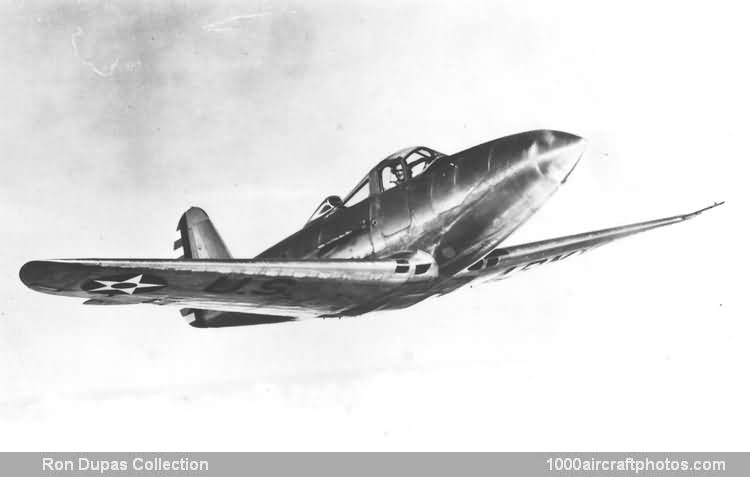
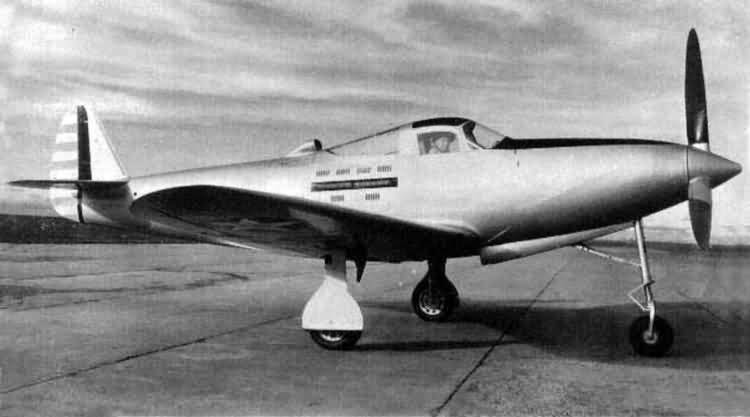
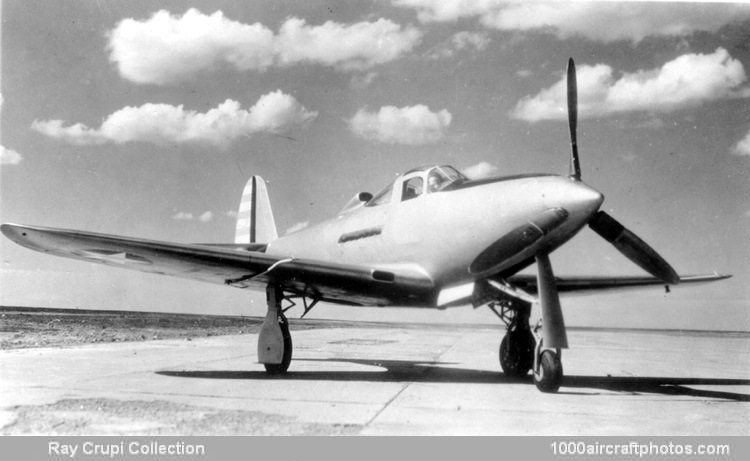
06/23/2025. Remarks by Johan Visschedijk: "In the mid-thirties, the main types of aircraft in the US Army Air Corps inventory were the Boeing P-26, Martin B-10B, Curtiss A-12 and the Douglas O-36; the first Seversky P-35s and Northrop A-17s had just been ordered. But all these were considered by the USAAC as interim types. A new generation of combat aircraft had to be designed. This situation was critical as far as fighters were concerned. At the time, some commercial aircraft were faster than the fighters on squadron inventory. That is why in 1936 the USAAC asked several manufacturers to submit for evaluation, among them was the newly born Bell Aircraft Company (July 10, 1935) in Buffalo, New York.
Chief-Engineer Robert (Bob) J. Woods and Chief-Designer began working on the single-seat fighter project in June 1936. On March 19, 1937, the USAAC issued specification No. X-609 for a new fighter. As this specification was not very precise, the Bell team could design without many constraints what it thought to be the ultimate fighter. It wanted to design an aircraft possessing great fire-power, excellent visibility for the pilot, good take off and landing characteristics, improved ground handling and, above all, superlative maneuverability.
Armament was a critical consideration. At the time, most American combat aircraft were lightly armed. Virtually no fighter had wing-mounted guns; all armament was in the nose above the engine. Thus, due to lack of available space, the only way to increase fire-power was to increase caliber. Woods had been very impressed by tests of the new 1.46 in (37 mm) T9 light gun designed by American Armament Corp, a subsidiary of Oldsmobile, and he decided to design the new aircraft around its armament. Two designs were then considered, one with a 0.984 in (25 mm) cannon and the other with the 1.46 in (37 mm) cannon. The barrels of both of these guns were too long; in consequence, the large engine had to be moved rearward and equipped with an extension shaft.
On the first design, called Model 3 under Bell terminology, the cockpit was also moved rearward, aft the engine. This position might not have been accepted for downward visibility. On the second design (Model 4), the positions were reversed: the engine was moved further aft and the cockpit installed in front of it, between the engine and the propeller. This configuration required an oversized extension shaft but, on the other hand, visibility was excellent and, above all, the engine was now placed very near to the center of gravity, a theoretically ideal position for good maneuverability. Another innovation was that both Model 3 and 4 had tricycle landing gears.
In May 1937, both designs were presented to the USAAC technical services and after careful study Model 4 was retained for further development. A contract was awarded on October 7, 1937, requiring the construction of a single prototype under the USAAC designation XP-39 (Model 11) (s/n 38-326). This was to be delivered by August 1938. Model 3 was put aside for a time but later served as a basis for the Bell Model 32. Construction of the prototype then began in Buffalo. The aircraft was of all-metal construction with fabric-covered control surfaces. The center wing section was integral with the fuselage and the outer wing panels, incorporating the main landing gear legs, were bolted to it. This later proved troublesome because it was impossible to remove the wing panels with the aircraft standing on its landing gear and required a crane and jigs.
The powerplant was a 1,150 hp Allison V-1710-17 twelve-cylinder liquid-cooled engine, equipped with a Type B-5 supercharger, the air scoop of which was installed on the port side of the fuselage. This engine drove a three-bladed propeller via a lubricated reduction gear and an articulated extension shaft in order to compensate for fuselage deformations under high-maneuvers.
At the beginning of spring 1938, construction was complete. The aircraft was then disassembled and taken to Wright Field for preliminary flight testing. The maiden flight was on 6 April, 1938, with dive-bomber pilot Lieutenant James Taylor (USN Ret) at the controls. Bell's John L 'Mickey' McCarthy was the crew chief. The XP-39 had not then received its armament and weighed only 6,204 lb (2,814 kg) and, during early flights, the speed of 390 mph (628 kmh) was reached and only 5 minutes needed to climb to 20,000 ft (6,096 m).
On 6 June, 1939, after some sixty flying hours had been logged, the XP-39 was sent to NACA's wind tunnel at Langley Field, Hampton, Virginia. These tests led to the removal of the supercharger and its intake, and the aircraft was sent back to Buffalo for modifications. These included an engine replacement (an l,090 hp Allison V-1710-39), the moving of the carburetor air intake to the back of the fuselage aft of the cockpit, wing span reduced to 34 ft (10.36 m), fuselage length increased to 29 ft 9 in (9.07 m) and a lowered canopy. All this led to a weight increase, the aircraft now weighed 6,450 lb (2,926 kg), and a designation change to XP-39B.