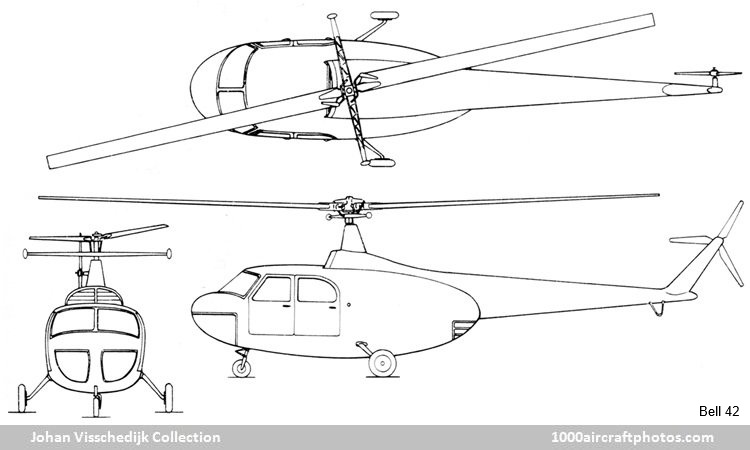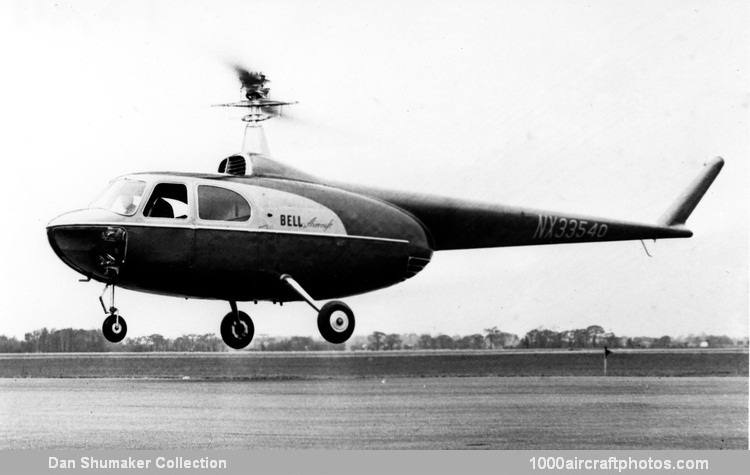
The rather modern looking Model 42 was a streamlined all-metal helicopter which could carry five people: the pilot's and co-pilot's seat were situated in the fore part of the cabin, and a cross bench for three passengers was located aft. Access to the cabin was via two car-like doors. As powerplant Bell's engineers selected the 450 hp Pratt & Whitney Wasp Junior R-985 nine-cylinder air-cooled radial. It was horizontally mounted in the rear fuselage and its adequate cooling was assured by a large air scoop located at the root of the main rotor mast.
The rotor, made of wood, was of the symmetrical airfoil section two-blade type with the now classic stabilizing bar; it had a reduction gear with a ratio of 8.987:1. In addition to the free-wheeling coupling, the transmission included a rotor brake. A three-bladed anti-torque tail rotor, also made of laminated wood, was located on the star-board side of the semi-monocoque tail boom. The undercarriage was of the fixed tricycle type.
Unfortunately for Bell, the Model 42 had been designed more as an aircraft than a helicopter and developed teething troubles. As Bell Helicopter public affairs specialist Richard S Tipton recalled, 'the Model 42 was a combination of beauty and the beast. Strip away the 42's comely cover and you'd find a monstrous tangle of cables winding around drums and a chamber of mechanical horrors'. Faced with un-expected difficulties, Larry Bell eventually decided to transfer the responsibility of the Model 42 development to the Gardenville team. After much work and redesign, Arthur Young and Bartram Kelley got most of the bugs out of the prototype (NX33540 c/n 1) and made it fly properly.
In December 1946, the Model 42 was displayed at the Cleveland Air Show. Unfortunately, in those days there was no potential market for such an aircraft. Two more examples were assembled and tested (NX42063 c/n 2 and c/n 3) but no firm orders were placed and the development of the Model 42 came to a halt. Nevertheless, the characteristic silhouette of the Model 42 would reappear months later with the military Model 48.
None of the Model 42 seem to have survived.
Rotor diameter: 47 ft 6 in (14.48 m)
Length over main and tail rotors: 55 ft 6 in (16.92 m)
Height over tail rotor: 13 ft 6 in (4.04 m)
Tail rotor diameter: 7 ft 5 in (2.25 m)
Empty weight: 3,355 lb (1,522 kg)
Useful load: 1,445 lb (655 kg)
Gross weight: 4,800 lb (2,177 kg)
Max weight: 5,100 lb (2,315 kg)
Max speed: 125 mph (200 kmh) at sea level
Cruise speed: 100 mph (160 kmh) at 75% power
Service ceiling: 13,000 ft (3,965 m)
Range: 300 mls (480 km)