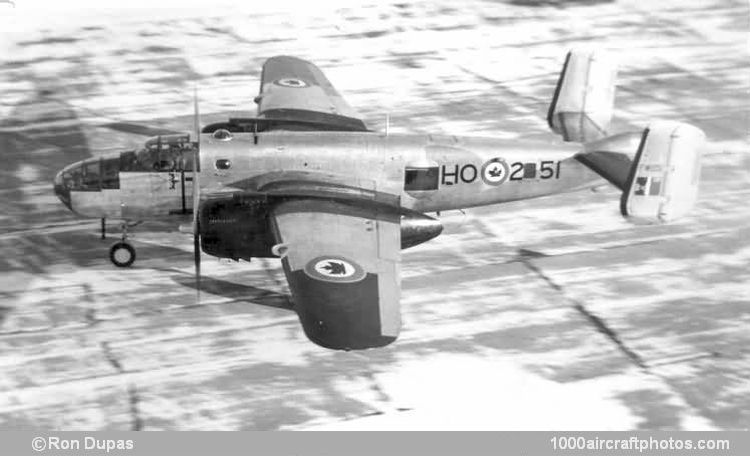
In general terms, the Mk.IIs were first modified during the war for use as pilot trainers, with most armament and associated gear (bomb sights, turrets, etc.) removed. They were stored in this configuration at the end of the war. When the Mitchell was selected for the Auxiliary Squadrons post war, they were modified to two standards:
Mk.2PT (note the change from Roman (II) to Arabic (2) number two) were pilot and crew trainers, basically in WW II configuration with Canadian designed and built winterization and communication and navigation equipment to then current RCAF standards. Note that the Mk.II was only used on the mild west coast during the war, while the Mk.2 with the Auxiliary Squadrons was intended to respond to a Russian invasion in the Arctic.
Mk.2LB were the operational versions for 418 and 406 Squadrons. They received similar modifications to the Mk.2PT, plus operational equipment was re-fitted. They had fixed nose guns and swiveling tail guns, but no top turret or side guns. The side blisters were retained for observation, but fully sealed against Canadian winters. From CEPE records, it seems they were qualified for the range of US "dumb bombs" also used by the Mustangs, Lancasters, Vampires, and later Sabres.
FW251 was modified to the Mk.2LB version at Avro Canada from October 1948 to March 1950; at Northwest Industries, Edmonton, Alberta, in 1951 and 1952; and at MacDonald Brothers in 1954. It also served most of its post war time with NWAC, Tactical Air Group, and later Tactical Air Command. 418 Squadron was part of all these commands, at various times. The Record Card shows FW251 with 406 Squadron, TAG, in 1952. On May 7, 1957 the aircraft was involved in a Category 'B' mishap."
Read the type remarks on page 9875. Thanks to Bill Walker and Pat Martin for their major input.