10/31/2007. Remarks by
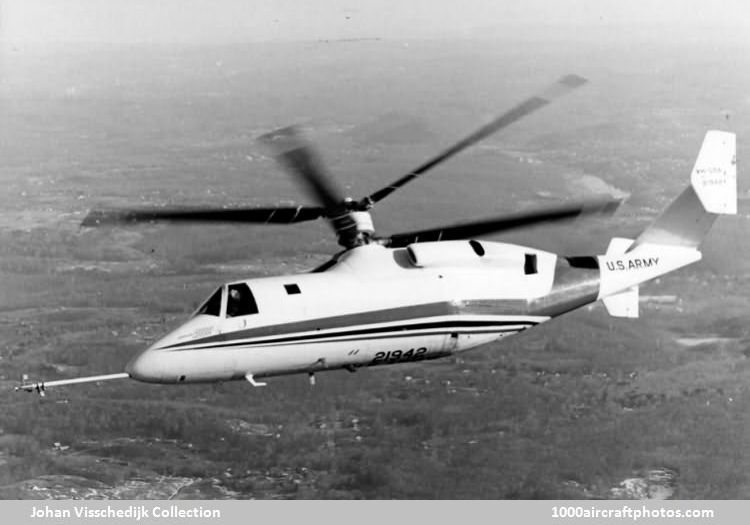
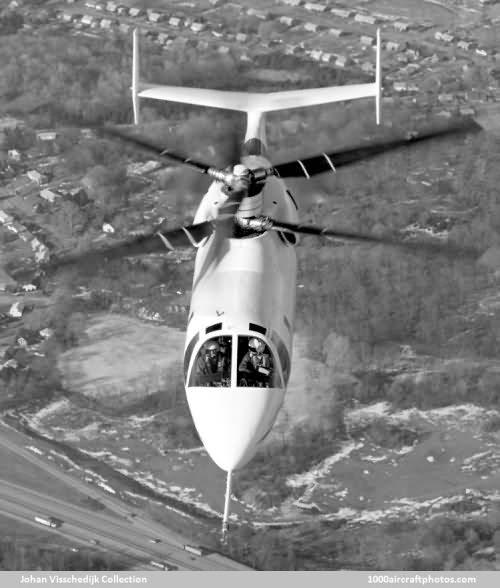
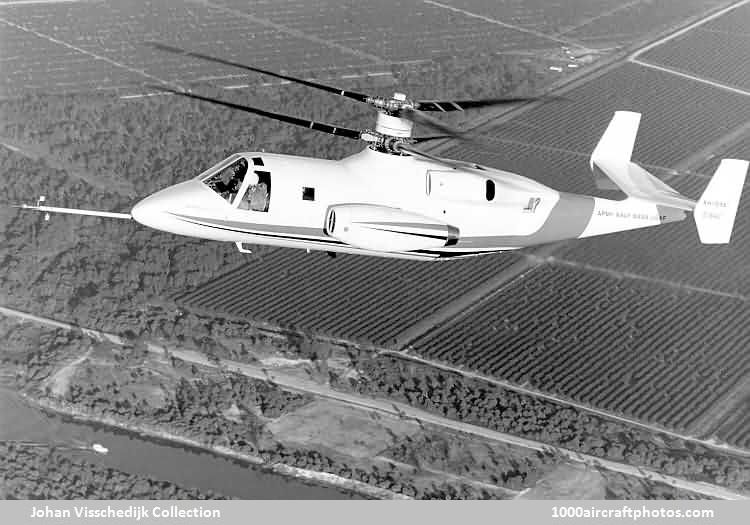
Johan Visschedijk: "On February 7, 1972, Sikorsky announced that the company, under contract to the Army Air Mobility Research and Development Laboratory, was designing and building a research helicopter, to study the Advancing Blade Concept (ABC) rotor system.
This new system consisted of two rigid, contra-rotating rotors that took advantage of the aerodynamic lift of the advancing blades. At high speeds, the retreating blades were unloaded, the majority of the load was supported by the advancing blades of both rotors and the usual penalties of retreating blade stall were eliminated. This system did not require a wing to supplement the rotor to provide speed and agility, and also eliminated the need for an anti-torque tail rotor and its drive system.
Powered by an 1,825 shp Pratt & Whitney PT6T-3B Twin-Pac the first XH-59A (73-21941) made its maiden flight on July 26, 1973, only to crash on August 24, being damaged beyond repair. The pictured second prototype had a number of design changes and a modified control system installed as a result of the crash investigation, and flew for the first time, as a pure helicopter, on July 21, 1975.
Late 1973 the ABC technology demonstrator became a compound aircraft when two 3,000 lb (1,361 kg) st Pratt & Whitney J60-P-3A turbojets were added for forward propulsion. It was flown early 1978 and evaluated by the US Army, USN and NASA. The aircraft is presently preserved at the Army Aviation Museum, Fort Rucker, Alabama, USA."