08/31/2011. Remarks by
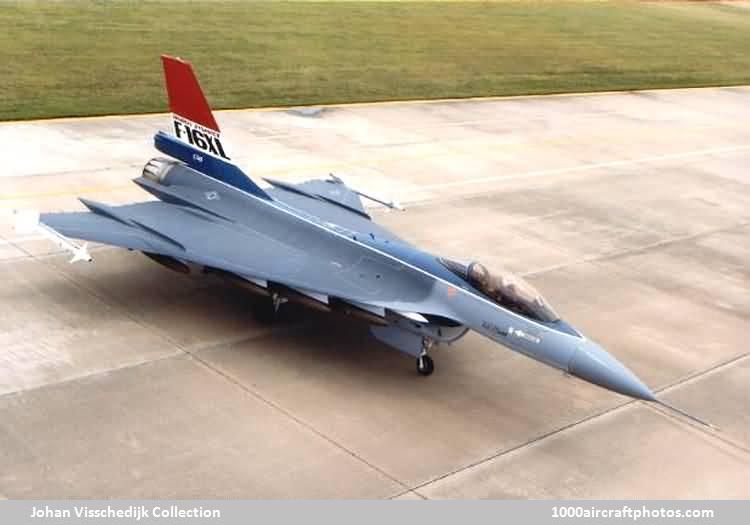
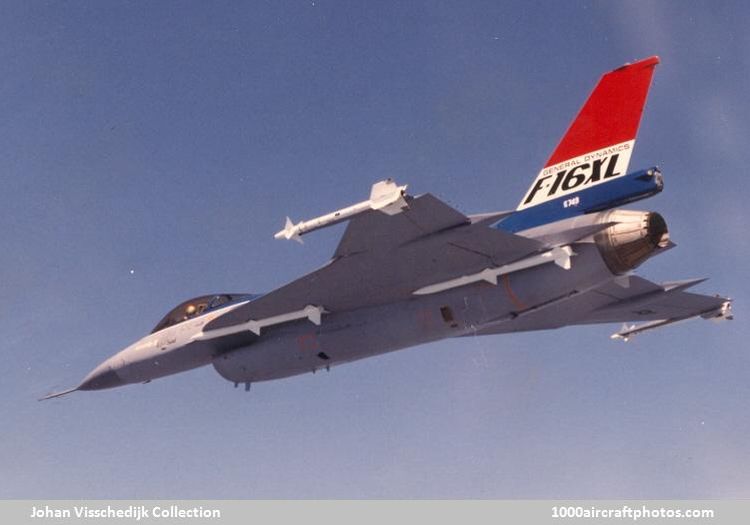
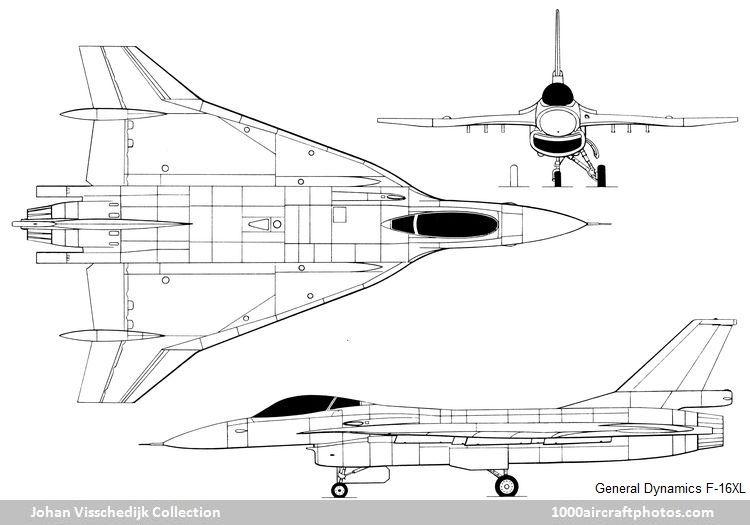
Johan Visschedijk: "Evolved as an advanced dual-role (air-air and air-ground) development of the F-16 Fighting Falcon incorporating new aerodynamic and systems technologies, the F-16XL featured a so-called "cranked arrow" wing with leading edge compound sweepback of 50 and 70°.
This wing was mated to an F-16 fuselage which was lengthened by 4 ft 8 in (1.42 m) by means of two plugs. The first (single-seat) prototype of the F-16XL (adapted from the first pre-series or full-scale development F-16A) flew on July 3, 1982, followed by a second (two-seat) prototype (which combined another pre-series F-16A and a new F-16B forward fuselage) on October 29, 1982. These were respectively powered by the F100-PW-102 and the F101DFE turbofan.
Despite its area of more than twice that of the F-16A, the "cranked arrow" wing of the F-16XL had less drag at optimum cruise, and permitted an 83% increase in fuel capacity. The long chord of the wing permitted tandem semi-conformal weapons carriage, four AIM-120 AAMs being semi-submerged under the wing at the fuselage intersection and an AIM-9 Side-winder AAM being carried at each wing tip.
On February 24, 1984, the US Department of Defense announced its choice of the McDonnell Douglas F-15E to fulfill the USAF's dual-role fighter requirement rather than the productionized F-16XL (F-16E). The two prototypes were subsequently leased by the NASA after being held in flyable storage for four years, flight testing resuming in March 1989 to evaluate concepts for sustained high-speed flight. The aircraft are stored at NASA Dryden Flight Research Center, Edwards, California."