WALTER VAN TILBORG MEMORIAL COLLECTION
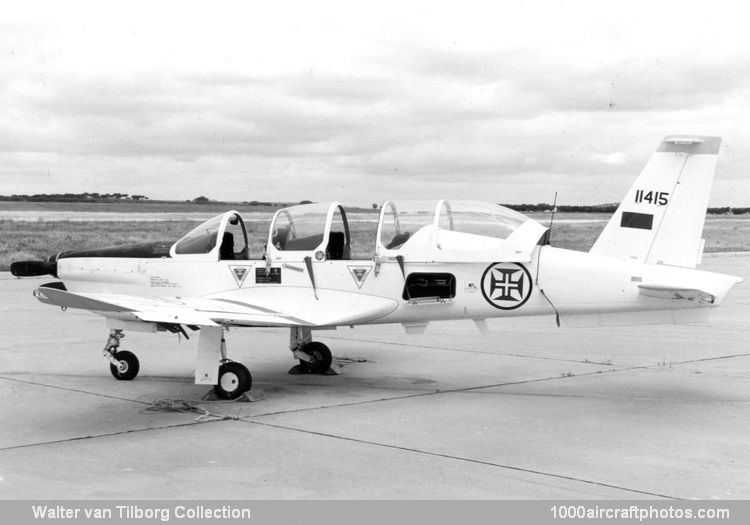
No. 2246. SOCATA TB 30 Epsilon (11415 c/n 172) Portuguese Air Force
Sourse unknown
02/08/2026. Remarks by
Johan Visschedijk: "Under the codename Epsilon the French AF issued a requirement for a propeller-driven aircraft for use in the initial stages of a more cost-effective pilot training scheme than that which was currently in operation. The first study was started in 1977 by the design bureau of Aérospatiale's Aircraft Division at Toulouse, in cooperation with Aérospatiale's subsidiary
SOCATA at Tarbes. It was a side-by-side derivate of the
SOCATA TB 10 Tobago with different wings and reinforced structure. However, by mid-1977, the French AF formulated the new trainer should be a tandem two-seater, subsequently the TB 10 derivate study was abandoned.
A development contract from the French AF for two prototypes and two ground test airframes, was announced by Aérospatiale in June 1979. Although Aérospatiale's Aircraft Division had done the initial development, design and production were entrusted to its division SOCATA Société de Construction d'Avions de Tourisme et d'Affaires, Construction Company of Touring and Business Aircraft) at Tarbes.
(
"VO") (
Johan Visschedijk Collection)
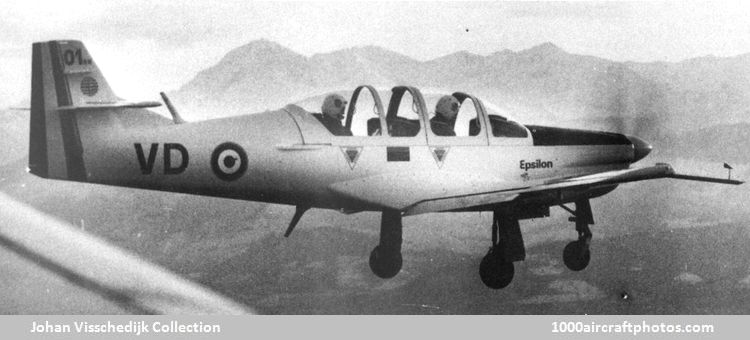
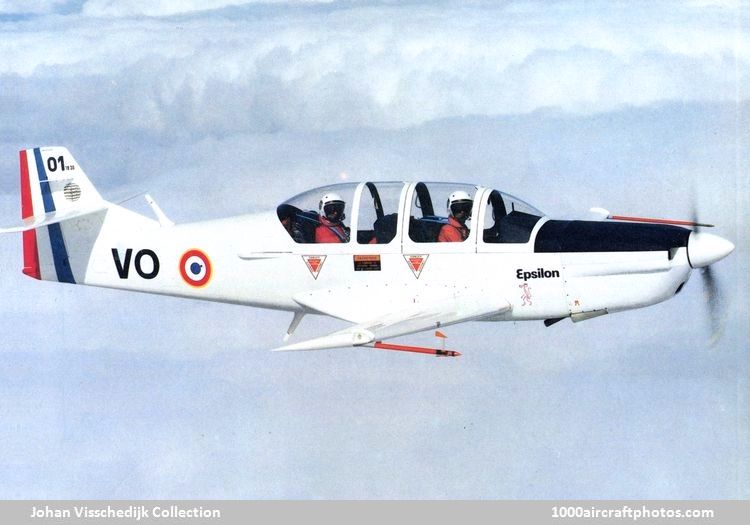
All Epsilons for the French AF were given a call sign, the last two characters being applied to the rear fuselage and prefixed with the squadron number. The two prototypes received the call signs F-ZWVO (c/n 01) and F-ZWVJ (c/n 02). Unfortunately, before the first flight no one had noticed the typo
"VD", soon after the first flight, the code was corrected to "VO".
With SOCATA chief test pilot Marc Yoh at the controls, and accompanied by Aérospatiale flight test engineer Claude Durand, the first prototype (c/n 01) flew on December 22, 1979. Powerplant was a 300 hp Avco Lycoming ΑΕΙΟ-540-L1B5D six-cylinder horizontally-opposed air-cooled engine, driving a Hartzell HC-C2YR two-blade constant-speed metal propeller.
(
"VO") (
Johan Visschedijk Collection)
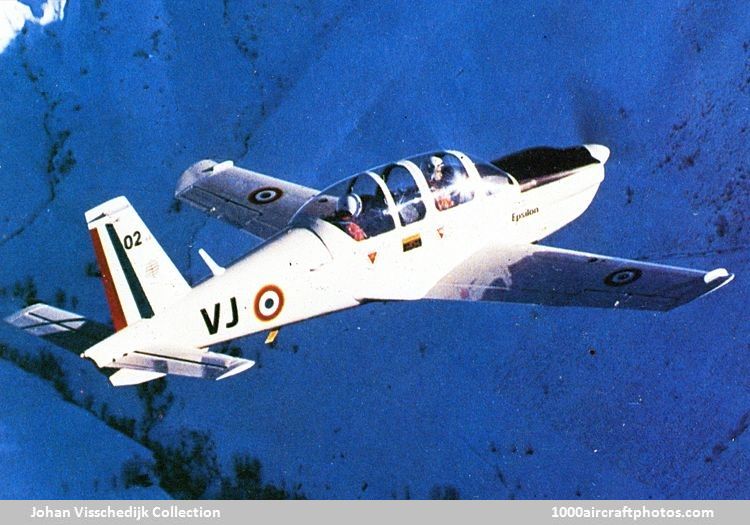
The second prototype, coded
"VJ" (F-ZWVJ c/n 02), was first flown by Aérospatiale flight-test director Henry Perrier and Aérospatiale test pilot Robert Briot on July 12, 1980.
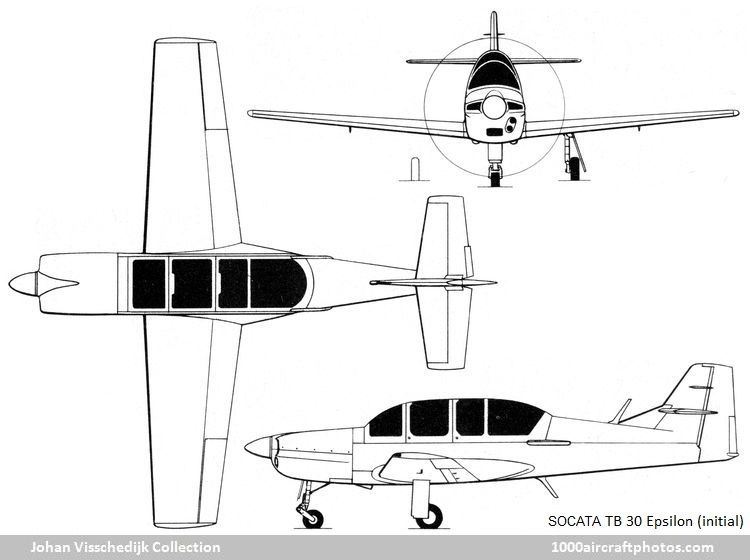
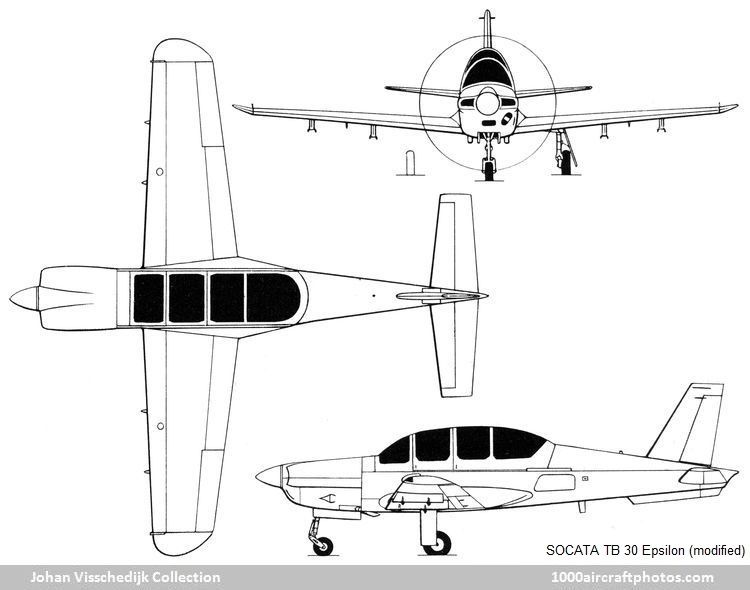
During following test flights pitch/yaw coupling problems revealed at large angles of sideslip, subsequently the empennage of the Epsilon was almost completely redesigned. The original fin was replaced by a sweptback unit, whilst the increased tailplane with dihedral was mounted at the bottom fuselage end, a ventral strake was added beneath the rear fuselage for additional directional stability. For better lateral stability slightly upwards turned elliptical tips were added to the wing to increase the effective dihedral of the wing. (Compare the 3-views at the bottom of the page.)
(
"VJ") (
Johan Visschedijk Collection)
The first prototype
"VO" was first modified with the above and first flew again on October 31, 1980, followed by the modified second prototype
"VJ" on December 17. In January 1981, a brief assessment indicated that the drastic changes had been successful in inducing a more reasonable behavior.
On January 6, 1982, a manufacturing program was approved, covering delivery of 150 Epsilons at the rate of thirty a year. On March 5, 1982, the contract for the first production batch was received. The first production Epsilon flew on June 29, 1983, deliveries to the CEAM (Centre d'Expériences Aériennes Militaires, Military Air Expertise Center) at Mont-de-Marsan began on July 29, 1983, and to flying school GE 315 (Groupement cole, Training Group) at Cognac-Chateaubriand on June 7, 1984. Following abandonment of plans to equip other flying schools, GE 315 had been issued with 150 Epsilons by late 1989.
(
"VO") (
Johan Visschedijk Collection)
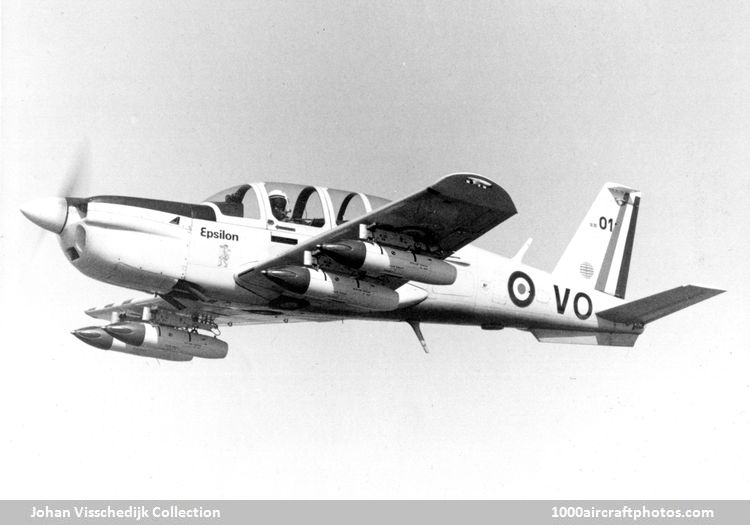
An armed Epsilon first flew in February 1983 in the form of the first prototype (F-ZWVO c/n 01) fitted with a SFOM 83A3 weapons sight and four hardpoints beneath the wing for Alkan 633 stores pylons. Simply designated the "Export" model, the armed aircraft had a slightly increased empty weight, raised max take off weight, and slightly reduced +/- g limits. The aircraft was capable of carrying 661 lb (300 kg) of ordnance in single-pilot configuration, this reducing to 441 lb (200 kg) with two in the cockpit.
Two demonstration Epsilons were also built. The first was registered to Aérospatiale as F-ZKFZ (c/n 3), later it was transferred to SOCATA. Preforming as a demonstrator into the late 1980s, whereafter it became a test bed when its engine was replaced by a 300 hp Morane-Renault diesel engine. Apparently not a success, the aircraft was subsequently withdrawn from service, and was stored at Tarbes-Lourdes-Pyrénées. There it was given the fake registration
'F-EMK2', standing for 'French Epsilon Mark 2'. In 2016 it was transferred to Armor Aero Passion at Morlaix-Ploujean, where it was dismantled.
(F-ZVLB) (
Johan Visschedijk Collection)
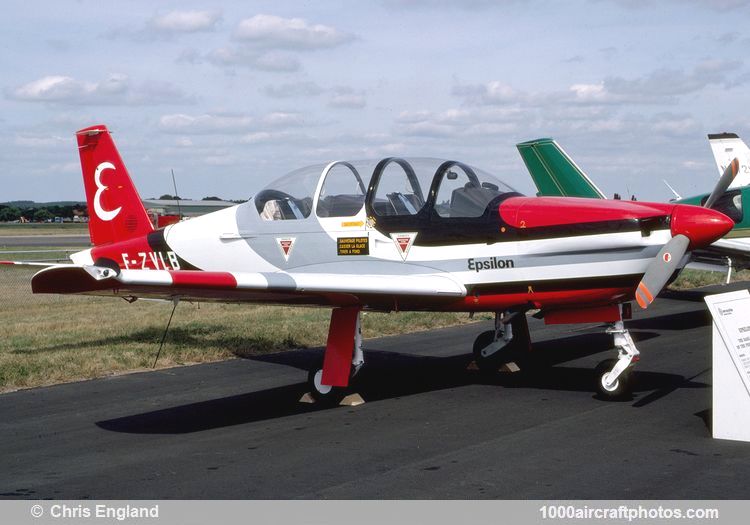
The second demonstrator was built some time after the first, this was registered to SOCATA as F-ZVLB (c/n 57). Alike the first prototype, F-ZVLB was also presented on many occasions in France and abroad. Presently it is preserved at Tarbes-Lourdes-Pyrénées.
Trivia: Both demonstrators often carried on the fin the lowercase fifth letter of the Greek alphabet: '
ε'. Came across remarks about this Greek letter in an Epsilon article written by aviation author and editor Paul Jackson in 1987:
Trials of the "Export" Epsilon began at CEV, Cazaux, in April 1983, and were completed in February 1984. By that time the third production Epsilon had been completed with the reinforced, weapon-carrying wing as a demonstrator, registered to Aérospatiale as F-ZKFZ (c/n 3). Between March 12 and April 23, 1984, it made a sales tour through seven African countries: Cameroun, Gabon, Ivory Coast, Nigeria, Senegal, Togo and Zaire (five of these were former French colonies). The sales tour resulted in only one order, from the Togolese AF in autumn of 1984, for three armed Epsilons. These aircraft were completed late in 1985, after crew training they were delivered in spring 1986. In 1988, a single attrition replacement was ordered.
ln October 1987, an order was announced for eighteen Epsilons for Esquadra 104 of the Portuguese AF at Sintra. The first of these was handed over at Tarbes on January 18, 1989, the remainder were assembled by the Portuguese AF establishment OGMA (Oficinas Gerais de Material Aeronáutico, General Offices of Aircraft Equipment) at Alverca, Portugal.
In all 177 construction numbers were issued: 2 for prototypes, 2 for demonstrators, 150 for French AF, 18 for Portuguese AF, 4 for Togo AF, 1 is unknown. From after the millennium turn on, Epsilons from the French AF were withdrawn from use. A considerable number became ground instructional airframes in France, while 10 sold/donated to the Senegal AF. Epsilons were also sold on the civil market, at least 52 went to the USA, 18 to France, and 1 to Belgium. The Epsilon era in the French AF ended with an official ceremony on September 24, 2019.
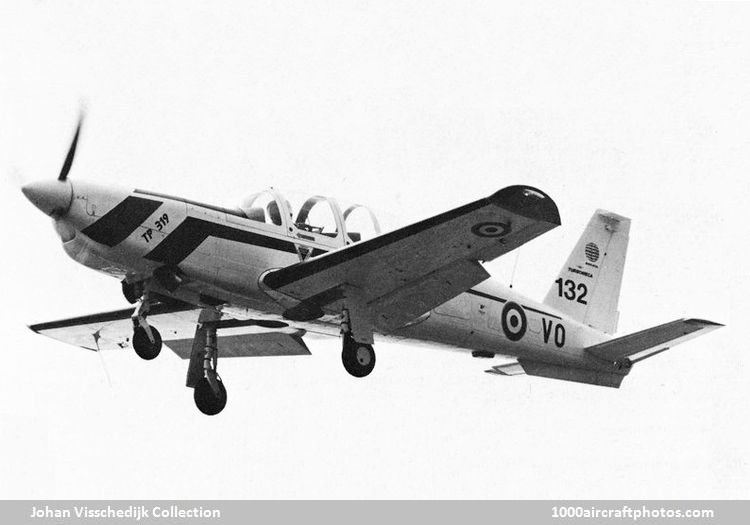
TB 30TP Epsilon with turboprop (F-ZWVO) (
Johan Visschedijk Collection)
In November 9, 1985, the first prototype (F-ZWVO) flew again with, instead of the Avco Lycoming AEIO-540-L 182D piston engine of 300 hp, a Turboméca TP 319 turboprop of 450 hp derated to 350 hp, in order to serve as a flying test bench for this new turbine. The Epsilon was redesignated TB 30TP. In June 1987 the TB 30TP was presented at the Paris Air Show, hence is carries the show catalog number
"132" on the tail.
Subsequently, the sole TB 30TP was used by SOCATA in the private venture to produce a new turboprop trainer, designated
SOCATA TB 31 Oméga.
The following description applies mainly to the basic version of the Epsilon, as operated by the French AF.
Created March 4, 2003