02/08/2026. Remarks by
Johan Visschedijk: "The British Air Council ordered two D.H.29 long range aircraft (serialed J6849 and J6850) for the Research Department of the Air Ministry. They were built at the de Havilland works at Stag Lane Aerodrome, Edgware, Middlesex, during the winter of 1920 but construction was not completed until the summer of 1921. They were historically important as the first British transport monoplanes to be fitted with thick section, high lift, cantilever wings and their design was developed from the (not built) smaller D.H.26 high wing project.
Well proven features of the faithful D.H.18 were retained, including the oleo damped rubber shock absorbers, controlled cooling and fuselage construction. Once again the main structure consisted of spruce longerons and cross struts strengthened with a plywood covering to keep the cabin space free of internal bracing, but to provide a suitable anchorage for the extra wide track undercarriage, the floor was made wider than the roof. This resulted in a pronounced 'tumble home' to the sides of the fuselage.
The tapered, cantilever wing was also of wooden construction, weighed 1,050 lb (476 kg) and was internally braced, fabric covered and fitted with differential ailerons designed by Assistant Designer A.E. Hagg. Fuel was carried in leading edge tanks of 138 gal (627 l) capacity and fed to the carburetors by gravity. A crew of two sat in an open cockpit (with the pilot on the starboard side), forward of a 13 ft 3 in (4.04 m) glazed cabin of 345 cu.ft (9.77 cu.m) capacity. Powerplant was a 450 hp Napier Lion IB twelve-cylinder liquid-cooled W-engine.
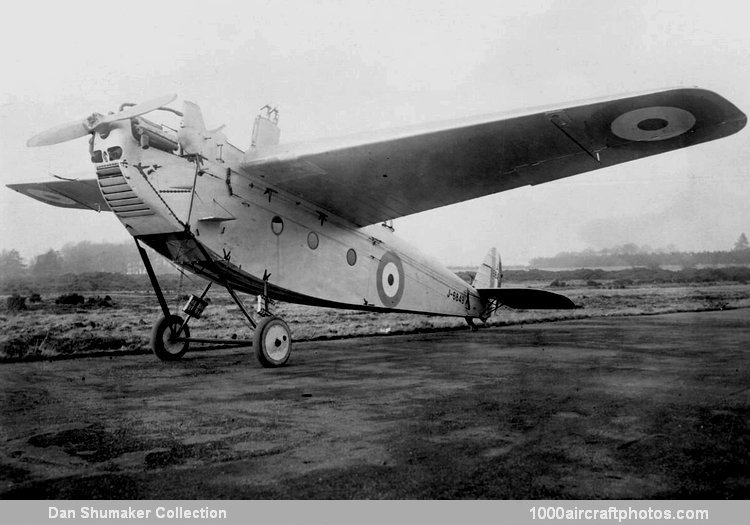
D.H.29 (J6849) in its original form with frontal radiator and low-set cockpit (
Johan Visschedijk Collection)
The first D.H.29 (J6849 c/n 7) was first flown at Stag Lane on July 5, 1921 by Capt. Geoffrey de Havilland, but with the engine thrust line coinciding with the center line of the fuselage, the cockpit received the full force of the slip-stream, and the pilot was subjected to excessive buffeting. Emergency hatches and clear doped panels in the roof were stove in and performance was reduced by the disturbed airflow over the center part of the wing. The ineffectiveness of the rudder was immediately apparent when the machine did a large diameter ground loop to port as the speed fell below 30 mph (48 kmh) on landing. The first passenger was flight test observer W.K. Mackenzie who flew in the left-hand seat when Capt. de Havilland made further test flights on July 7, 11 and 12.
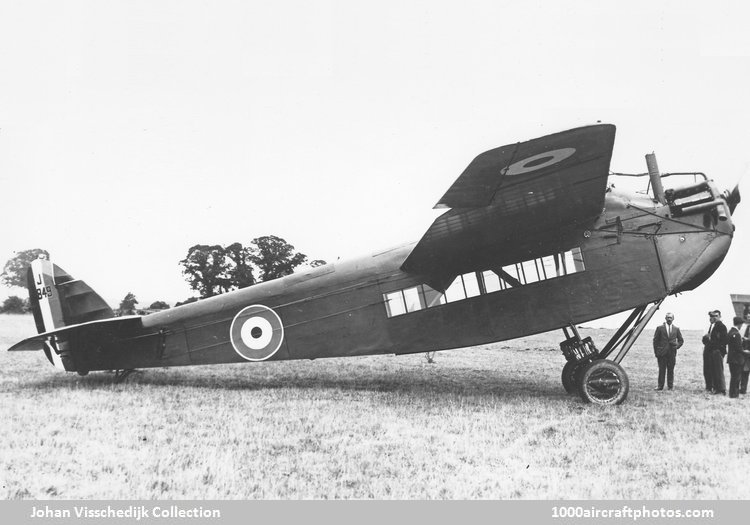
D.H.29 (J6849) revised with raised engine and cockpit, and internal radiator compartment (
Johan Visschedijk Collection)
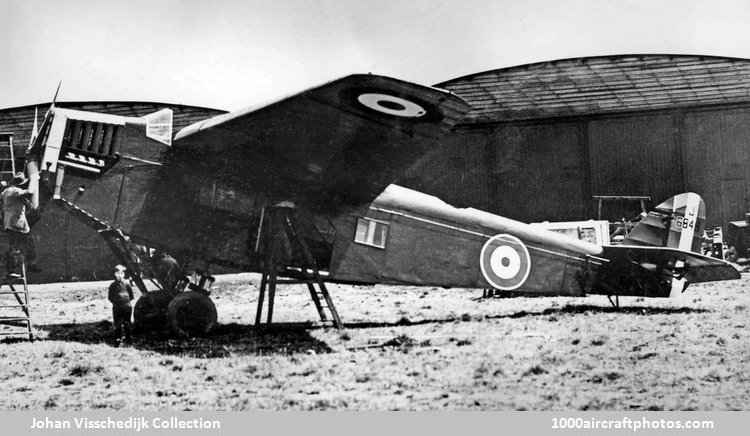
In a vain attempt to improve directional control, a new nose was built to raise the power plant by 20 in (51 cm) but as the original fuel tanks no longer gave a sufficient head of petrol, a low-pressure fuel system was installed which necessitated the addition of a streamlined header tank on top of the centre section, surmounted by two wind driven pumps. It was also considered advisable to replace the original unbalanced elevator with a horn balanced unit after which, in January 1922, the aircraft went to Martlesham for official trials.
As visible in the photo on top of the page, the cabin was subsequently modified to have three small portholes in place of the original sliding windows, and equipped for photographic and wireless experiments. Later a gunner's cockpit fitted with a Scarff ring was built on top of the fuselage aft of the wings and thereafter the aircraft was known officially as the Doncaster.
It was flown from Martlesham to the RAΕ Farnborough on April 17, 1924 and in the following month was used for a series of 'Control of Doncaster' tests.
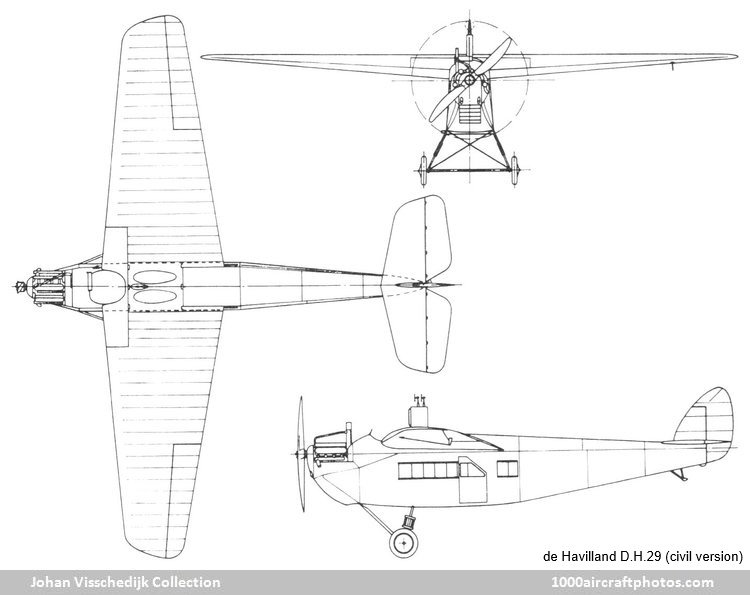
The unnamed second D.H.29 was completed in August 1921 as a commercial aircraft seating ten passengers. It did not take up the serial J6850 but on September 28, 1921 it was registered to the de Havilland Aircraft Company as G-EAYO (c/n 8). Wicker chairs were arranged with a gang-way down the middle and a communicating door in the front bulkhead gave access to the pilot's cockpit. Progress in aeronautical design had been so rapid that although only five years had passed since the introduction of the two-seat D.H.4, an aircraft with approximately the same wing area could now carry twelve persons. It also lifted a greater load than the D.H.18, even though powered by the same engine.
Daimler Hire Ltd. showed considerable interest in the D.H.29 but although its differential ailerons imparted exceptional lateral control, other control problems came to light which were not fully understood at the time, and the rudder was ineffective when taxying. The need for new flying stock was so urgent that the company was forced to order the D.H.34 biplane instead and the civil D.H.29 G-EAYO thus saw no commercial service. Its only recorded public appearance was before delegates to the Imperial Air Conference at Croydon on February 3-6, 1922 where it was exhibited statically in the Aircraft Disposal Company's hangar and flown on the final day.
On November 9, 1922 G-EAYO joined the first prototype at Martlesham where both aircraft took part in a very considerable program of test flying and made valuable contribution to a fuller understanding of the behavior of thick section cantilever wings. G-EAYO returned to Stag Lane where Hubert Broad made the first of several test flights on July 18, 1923, climbing to 10,000 ft (3,048 m) with Hessell Tiltman as observer on July 20 and 24. They ferried it back to Martlesham on September 13 and next day made a full load test at the all-up weight of 7,500 lb (3,402 kg).