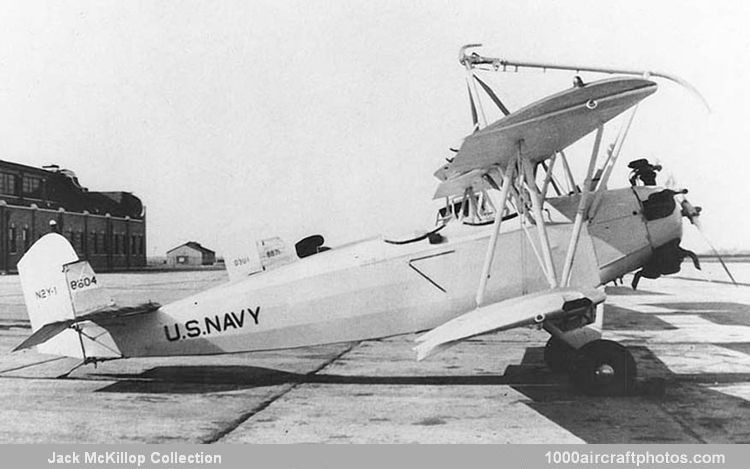
03/31/2008. Remarks by Jack McKillop: "The USN signed a contract with the Goodyear-Zeppelin Corporation of Akron, Ohio, in 1928 to build two rigid scout airships, later named USS Akron (ZRS-4) and USS Macon (ZRS-5). These airships were unique in that they contained a 60 by 75 ft (18 by 23 m) hangar that could accommodate four small aircraft.
USS Akron was commissioned in 1931 and USS Macon in 1933. Aircraft would be launched and retrieved by means of a trapeze mounted underneath the airship. The aircraft would have a "skyhook" to hook on to the trapeze and then be swung up into the hangar area.
In order to train Naval aviators in this technique of launching and retrieval, a temporary trapeze was mounted below the rigid airship USS Los Angeles (ZR-3). The USN also needed a training plane for operations involving the trapeze and in 1929, they tested a Fleet Model 1 two-seat biplane as the XN2Y-1 (BuNo. A-8019).
By March 1930, Fleet Aircraft, Inc. had been purchased by the Consolidated Aircraft Corp. and the USN ordered six modified Fleet Model 2s as N2Y-1s (BuNos. A-8600 to A-8605, c/n 264 to 269). These six aircraft were initially assigned to USS Los Angeles and later to USS Akron and USS Macon for training duties.
USS Akron crashed off the New Jersey coast in 1933. The following year, Waco XJW-1s were assigned to the USS Macon and three of the N2Y-1s (BuNos. A-8600 to A-8602) were placed in storage. A-8604 crashed in July 1934, and the other two (A-8603, A-8605) served as utility aircraft in the aircraft carriers USS Saratoga (CV-3) and USS Ranger (CV-4) until they were withdrawn from use, A-8605 is preserved at the National Naval Aviation Museum, Pensacola, Florida.
In 1934 the stored A-8602 was converted to the XN2Y-2 twin-float seaplane and soon thereafter it was converted to an experimental autogyro floatplane and redesignated XOZ-1."