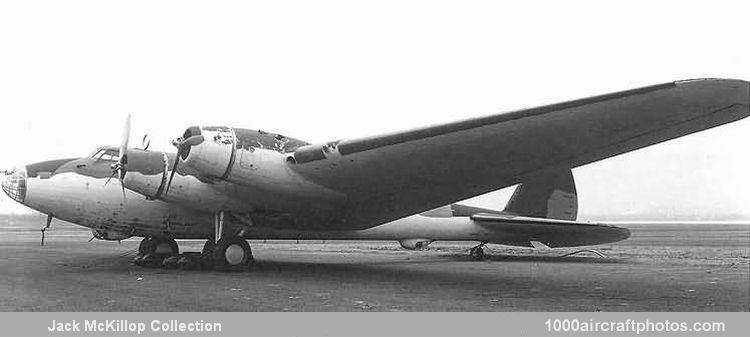
05/31/2006. Remarks by Jack McKillop: "This aircraft was originally designated XBLR-1 (Experimental Bomber, Long Range) but it was redesignated XB-15 in July 1936 before delivery. The XB-15 made its first flight on October 15, 1937 and it subsequently set several world records for load carrying including a 71,167 lb (32 281 kg) payload to 8,200 ft (2,499 m) on July 30, 1939, and a payload of 4,409 lb (2,000 kg) 3,107 miles (5,000 km) at 166 mph (267 kmh).
The photo above shows the aircraft painted in water colour camouflage and was taken at Bolling Field, Washington, District of Columbia, USA, during an Air Corps display on January 12-14, 1940.
In service for eight years, the XB-15 served with two squadrons at Langley Field, Hampton, Virginia, USA, the 49th Bombardment Squadron (Heavy), 2d Bombardment Group (Heavy) between 1938 and 1940, and the 41st Reconnaissance Squadron (Heavy), 2d Bombardment Wing between 1940 and 1942. This aircraft was assigned to Sixth Air Force in the Caribbean and arrived at the Panama Air Depot (PAD), Albrook Field, Canal Zone, on March 23, 1943.
This aircraft was underpowered and was never placed in production but was used for experimental tests. Because of its cargo-carrying capacity, it was redesignated XC-105 on May 6, 1943 and was modified by the PAD. After modification, it was assigned to the 20th Troop Carrier Squadron, Sixth Air Force Service Command, based at Albrook Field in December 1943.
During its eight year in service, the XB-15/XC-105 flew 60 combat missions including ASW patrols and 70 cargo trips carrying 5,200 passengers, 440,000 lb (199,581 kg) of cargo and 94,000 lb (42,638 kg) of mail. The XC-105 was placed in storage at the PAD in May 1944 due to structural damage. This one of kind aircraft was ignominiously shoved into the Curundu Swamp, east of Albrook Field, where it slowly sunk into the muck. It remains there to this day."