02/08/2026. Remarks by
Johan Visschedijk: "The single-seat Termite was designed by Wilbur "Smitty" L. Smith of Bloomington, Illinois, USA. Construction of the Termite was started in 1956, for the prototype Smith used spars from an
Aeronca K, while the controls were modified from a
Piper Cub. The powerplant was a 36 hp Aeronca E-113-C two-cylinder horizontal-opposed air-cooled engine. It had no brakes, nor a tail wheel.
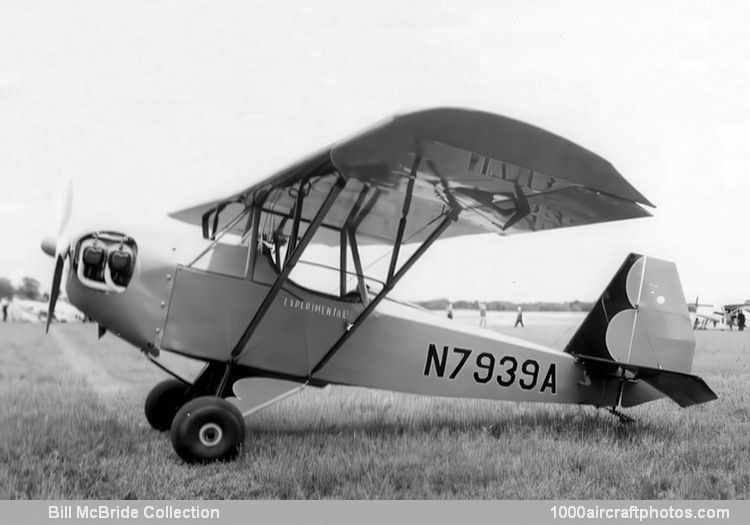
On February 10, 1957, registered N7939A and named "Smith Special" the prototype was first flown, exceeding all of "Smitty's" expectations. It had a top speed of 93 mph (150 kmh), it cruised at 78 mph (126 kmh), and a climb of 450 ft (137 m)/min. Subsequently brakes and a tail wheel were fitted, later a 38 hp Continental A40-5 and a 65 hp Lycoming O-145 were successfully tested.
On the photo the N7939A shows the four-cylinder engine and a revised fin and rudder. The aircraft is on display at the Oregon Air and Space Museum in Eugene, Oregon. In 2024 the Smith family disposed the rights, plans are still available from Adams Aeronautics Company at Jasper, Georgia.
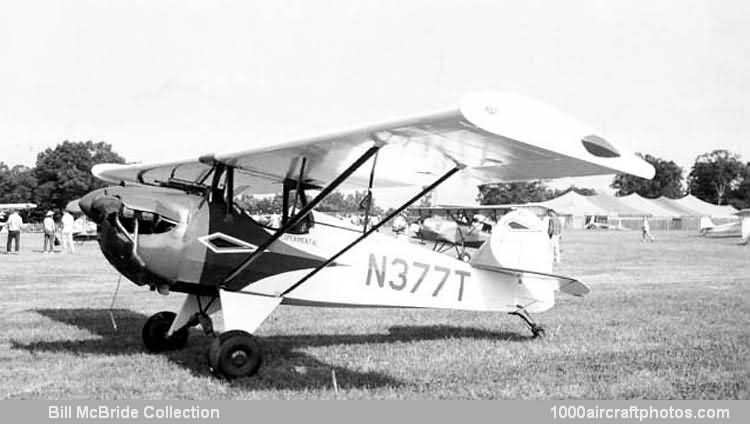
Smith Termite (N377T)
This Termite was constructed by Joseph E. Tyndal of Richmond, Virginia, from plans provided by Wilbur Smith. Powered by a 65 hp Lycoming O-145, and registered N377T it was flown for the first time on June 5, 1960. It differed from the original by having the wing span enlarged by 2 ft 6 in (0.76 m) to 26 ft (7.92 m), endplates, a wheel control instead of a stick, a glass fiber cowling, and two dummy 3/4-scale machine guns just in front of the cockpit. Reportedly also designated Smitty's JT-1 Termite, the aircraft's last registered owner was the
EAA, its registration being cancelled on July 11, 1984.
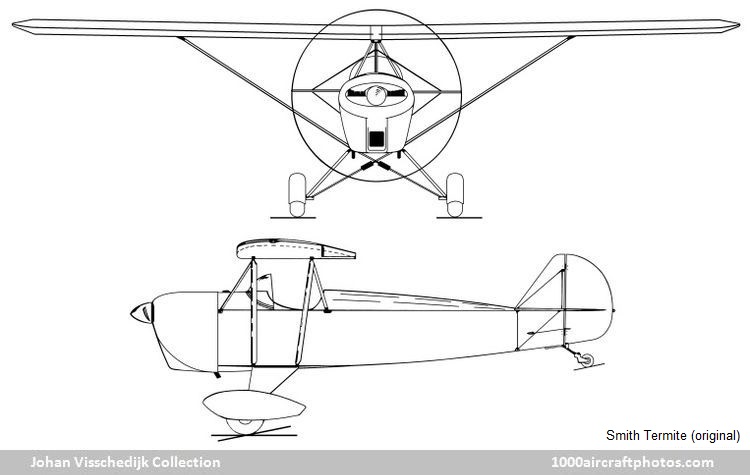
The following data apply to the standard Termite, built from Smith's plans, performance data at max. weight.
Type: Single-seat open sporting monoplane.
Wings: Braced parasol monoplane, with two parallel streamline-section metal bracing struts each side and six bracing struts between fuselage and center wing. Wing section Clark Y. All-wood two-spar structure. Aluminum-covered leading edge. Fabric covering aft of front spar. Fabric-covered wood ailerons.
Fuselage: All-wood structure, plywood-covered to rear of cockpit, with fabric covering on rear fuselage.
Tail unit: Wire-braced wood structure, except for steel tube leading- and trailing edges. Fabric-covered.
Landing gear: Non-retractable two-wheel type. Main units of Piper Cub type. Goodyear wheels, size 7.00-3. No brakes. Spring steel tailskid.
Power plant: One 38 hp Continental A-40-5 four-cylinder horizontally-opposed air-cooled engine driving a two-blade wooden fixed-pitch propeller. Fuel tank aft of firewall, capacity 6 gal (22.7 l). Alternatively one 65 hp Lycoming O-145 or Continental A-65 engine, with additional 5 gal (18.9 l) wing tank.