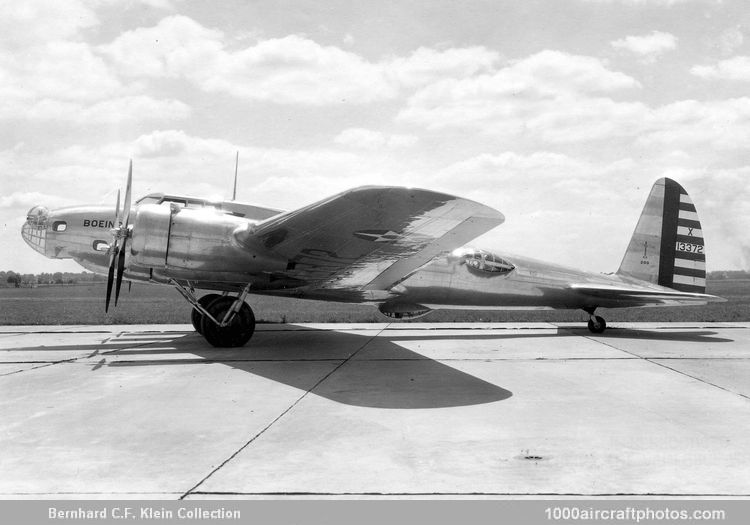
12/15/2005. Remarks by Bernhard Klein: "Boeing started the design of the four-engined eight-seat Model 299 in June 1934 as a private venture to the specifications issued by the USAAC the previous month, stipulating a multi-engined bomber capable of carrying a ton of bombs at more than 200 mph over a distance of 2,000 miles.
Construction started on August 16, 1934 and with Boeing test pilot Leslie R. Tower at the controls the maiden flight took place at Seattle, Washington on July 28, 1935. It was painted in standard USAAC markings on tail and wings but with the Boeing designation and civil registration X13372 on the wing and tail. It was powered by four 750 hp Pratt & Whitney R-1690E S1EG Hornet nine-cylinder air-cooled radials.
To be tested by the USAAC the Model 299 went to Wright Field, Ohio, on August 20, 1935, and was designated B-299. Tests resulted in a order for 65 service test aircraft designated YB-17 (Boeing Model 299B), however, the B-299 crashed on October 30, 1935, at Wright Field, due to inadvertently locked tail surfaces. Pilot Ployer P. Hill (chief of Wright Field's Flight Testing Section) and Leslie Tower were killed.
Due to limited funds the order was cut back to 13 aircraft on January 17, 1936, while on November 20, 1936, the designation was changed to Y1B-17, the "Y1" designation indicating that they were purchased from "F-1" funds (direct purchases rather than from regular appropriations via requests for the FY budgets). The first Y1B-17, s/n 36-149, was flown on December 2, 1936."