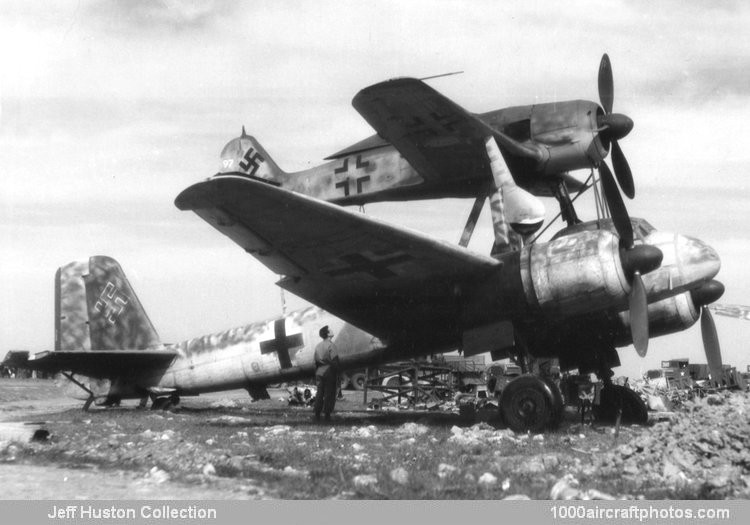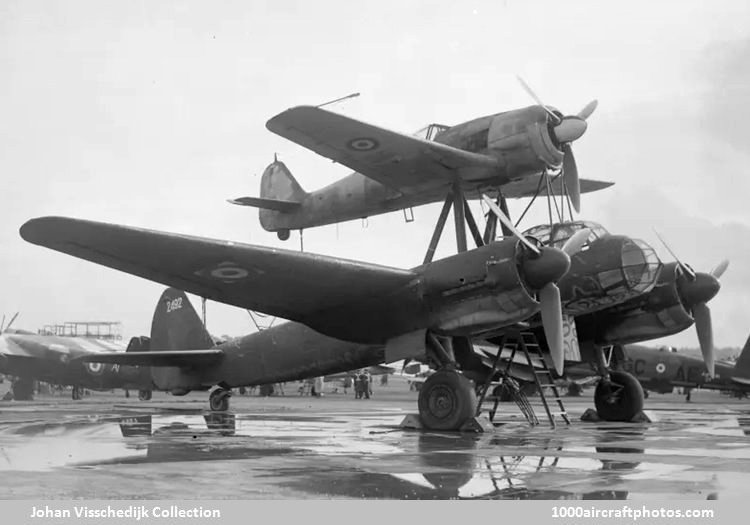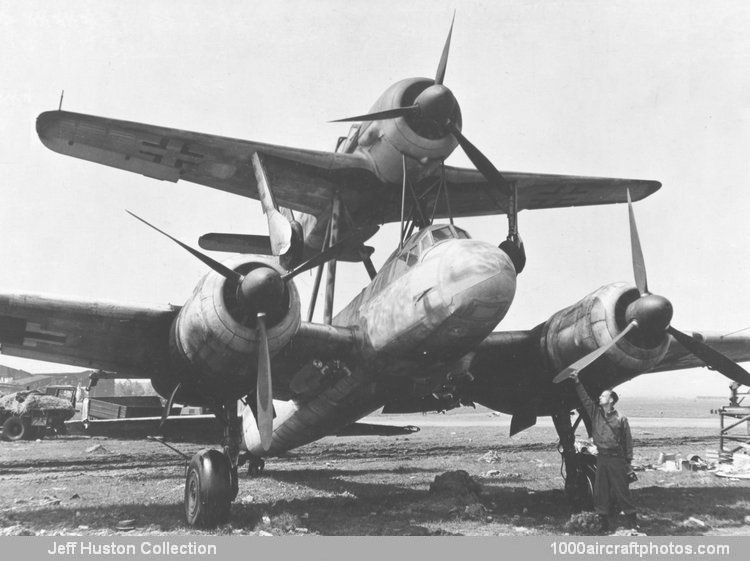
Stamer's study was an unorthodox 'pick-a-back' composite arrangement originally envisaged for aerial-tug purposes. In 1942 he used a DFS 230 glider as the lower component of a composite pair, the upper component eventually being a Messerschmitt Bf 109 E fighter. The success of flight trials prompted the RLM to study the possibility of using the Junkers Ju 88 A-4 and Bf 109 F, the bomber component being a crewless flying bomb whose engines provided power for an outward flight to the target. Codenamed Mistel (Mistletoe) this tactic was pursued by DFS who developed the interconnecting superstructure, while a guidance and control system was undertaken by DFS, Junkers and Patin.
Under the weapon codename Beethoven, the Junkers Ju 88 A-4 flying bomb was modified to incorporate additional fuselage fuel tanks and a 7,715 lb (3,500 kg) hollow-charge warhead with a 2,200 lb (1,000 kg) steel core which theoretically was capable of penetrating 24 ft 7 in (7.5 m) of armor. In practice a core penetrated 60 ft 9 in (18.5 m) of concrete, a result which indicated its potential destructive force against bridge targets.
By April 16, 1944 plans had been laid for possible attacks by the weapons on Gibraltar (British Oversea Territory), Leningrad (USSR) and Scapa Flow (sheltered bay in Orkney Islands, Scotland) and 2/KG 101 was formed under Hauptmann Horst Rudat who set up a training station at Kolberg (presently Kołobrzeg, Poland on the Baltic Sea) with five Mistels.
As preparations were being made to launch a Mistel attack on Scapa Flow, the Allied landings in Normandy caused 2/KG 101 to be moved to St Dizier, France. The attack was made on the night of June 24/25, 1944 against shipping in the mouth of the Seine, the Mistels being escorted by Bf 109 Gs of I/JG 301. Feldwebel Saalfeld was the pilot of the first of five aircraft to attack and four ships were hit. Other attacks followed, one Beethoven impacting near Andover, Hampshire, England, and another near Maidstone, Kent. The Scapa Flow attack was eventually launched in October by five Mistels of 2/KG 101, by then redesignated III/KG 66, but three crashed pre-maturely and the other two pilots became lost.
Meanwhile the Mistel force was being enlarged substantially. New versions of the Ju 88 were being employed, and II/KG 200 was activated with three operational squadrons. Combinations now included Bf 109 Fs, Focke-Wulf Fw 190 As and Fw 190 Fs with the Ju 88 A, Ju 88 G, Ju 88 H and Ju 88 S, as well as the Ju 188 A and Ju 188 E.
The gravity of the situation on the Eastern front forced abandonment of further attacks on Scapa Flow, and instead Unternehmen Eisenhammer (Operation Iron Hammer) was formulated to use Mistels against Soviet power stations. At the same time II/KG 200 embarked on a series of attacks on key road and rail bridges, the first on March 9 against the twin Görlitz bridges over the river Neisse (border Germany-Poland), both of which were hit. Other raids were then launched against bridges over the rivers Vistula (Poland) and Rhine (Germany).
In all something over 200 Mistels entered operational service during the last four months of the war, and attacks, many of them successful, were made on bridges over the Bober, Küstrin, Oder and Quais rivers, flying from Marienehe, Oranienburg, Parchim and Rechlin-Lärz. Allied air supremacy over Germany, however, soon rendered further efforts impossible. On February 3 four out of six Mistels were shot down by Allied fighters near Hamburg, and on April 9 American bombers destroyed the Mistel base at Rechlin-Lärz. The last Mistel attack was mounted on April 16 against Russian forces in the East.
Manufacturer: Junkers.
Model: Mistel (Mistletoe).
Type: Unmanned expendable (composite) attack aircraft.
Power Plant: Two 1,340 hp Junkers Jumo 211 J-2; plus one (optional) 1,350 hp Daimler-Benz DB 601E-1.
Crew: 1.
Variants:
Prototype: One Bf 109 F-4 (upper) coupled to one Ju 88 A-4 (lower) by DFS-designed connecting/release structure.
Mistel 1: Bf 109 F-4/Ju 88 A-4 combination; Ju 88 nose section replaced by 8,380 lb (3,800 kg) hollow-charge warhead with impact fuse projection; strengthened structure.
Mistel S1: Trainer version of Mistel 1; additional forward bracing struts.
Mistel 2: Improved Mistel 1; Fw 190 A-6 (or Fw 190 F-8)/Ju 88 G-1 combination.
Mistel S2: Trainer version of Mistel 2.
Mistel 3: Improved Mistel 2; additional jettisonable third main-wheel under fuselage.
Mistel 3A: Fw 190 A-8/Ju 88 A-4 combination.
Mistel S3A: Trainer version; Fw 190 A-6/Ju 88 A-4 (or Ju 88 A-6) combination.
Mistel 3B: Fw 190 A-8/Ju 88 H-4 combination.
Mistel 3C: Fw 190 A-8 (or Fw 190 F-8)/Ju 88 G-10 (or Ju-88 H-4) combination; additional fuel capacity.
Total Mistel Production: 250+.
Mistel Führungsmaschine (leading aircraft): Long-range pathfinder version of Mistel 3B; Ju 88 H-4 with 3 crew, one rearward-firing 0.511 in (13 mm) MG 131, and centimetric radar in extended nose.
Mistel 4: Projected Messerschmitt Me 262/Ju 287 combination.
Mistel 5: Projected Me 262 (or He 162)/Ju 268 (or Arado E-377A) combination.