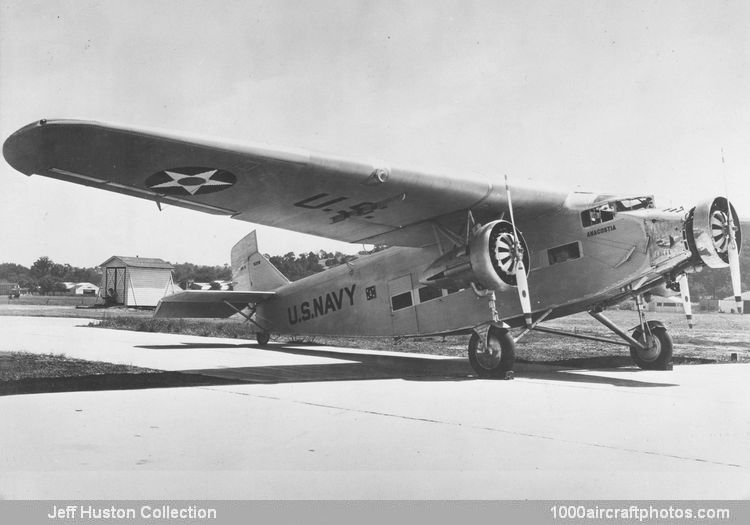
06/23/2025. Remarks by Johan Visschedijk: "The Ford Tri-Motor gained quick acceptance by airlines in the US and elsewhere, and deliveries from the production line began before the end of 1926. Nine examples of the famed Ford Tri-Motor Model 4 and Model 5 versions went into service with the US Navy and US Marine Corps between 1927 and 1931 and gave good service until 1935. The name Ford Tri-Motor was not used by the USN nor by the USMC.
The first USN contract was placed on March 9, 1927, for a single example of the Model 4-AT designated XJR-1 (BuNo. A-7526 c/n 4-AT-4) as a personnel and cargo transport. It was built in 1927 and tested at Anacostia in 1928, then served until being written off in April 1930.
Two of the improved Model 4-AT-Es were purchased as JR-2s (A-8273 c/n 4-AT-59, A-8274 c/n 4-AT-60) in 1929, and both went into service with the USMC.
Three JR-3s were Model 5-AT-Cs with an enlarged wing, the first went to the USN (A-8457 c/n 5-AT-72) and two others to the USMC (A-8598 c/n 5-AT-82, A-8599 c/n 5-AT-83) in 1930. The JR-2 and JR-3 designations were changed to RR-2 and RR-3 shortly after, when the Navy adopted the R for transport aircraft. A single RR-4 (A-8840 c/n 5-AT-84), also a Model 5-AT-C, went to the USN. Finally, two Model 5-AT-Ds were acquired as RR-5s, one each for the USMC (9205 c/n 5-AT-105) and the USN (9206 c/n 5-AT-113), the latter is pictured above.
One other Tri-Motor was tested by the Navy but not taken on charge: this was the Model 5-AT-CS (NC414H c/n 5-AT-74) fitted with two 30 ft (9.14 m) floats and operated as a seaplane at the Philadelphia Navy Yard, where its suitability as a torpedo-bomber was studied."