DAVID J. GAUTHIER MEMORIAL COLLECTION
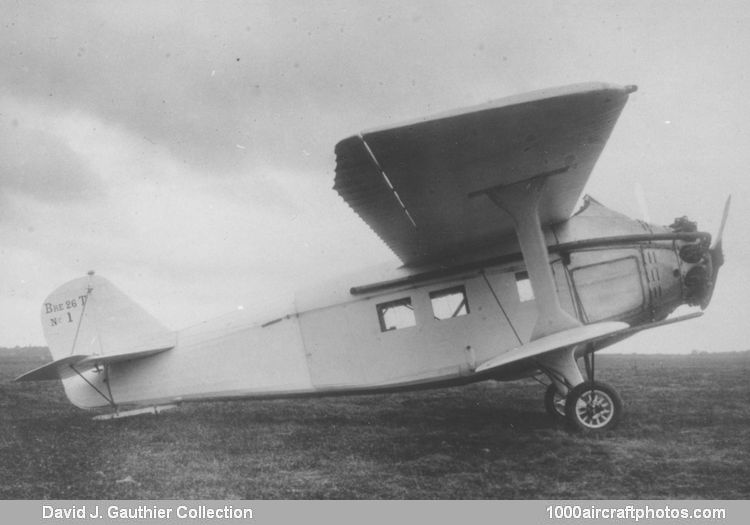
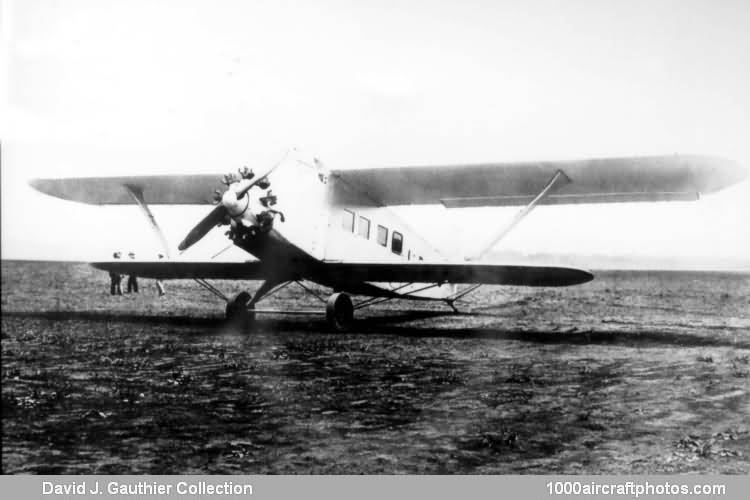
No. 9279. Breguet Bre 26 T (c/n 1)
No. 9279. Nakajima N-36 (J-BAYO c/n 2)
Sources unknown
02/08/2026. Remarks by
Johan Visschedijk: "In 1921 Breguet built the first of its Breguet Bre 19 two-seat multi-purpose biplanes. These were built in large numbers and in many versions, used by numerous air forces and for some outstanding long-distance flights. A design study was produced for the Breguet Bre 19 T six-passenger commercial transport, however, this was never built but served as a basis for the Breguet Bre 26 T.
The aircraft was of metal construction with metal-covered forward fuselage and fabric-covered wings, rear fuselage and tail unit. The upper wing had greater span and chord, and it alone had ailerons. There were single I-type interplane struts which branched into faired Ys at top and bottom. The fuselage filled the entire gap between the wings. The cabin had seats for six passengers, and the pilot's open cockpit was high in the nose just forward of the leading edge. There were baggage holds both forward and aft of the cabin. The landing gear had a single leg on each side, there was a spreader bar, and wire bracing ran from the axle ends to the lower wings.
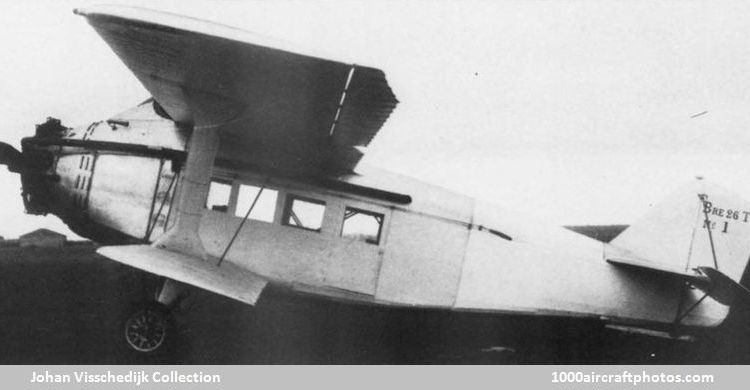
Bre 26 T (
Johan Visschedijk Collection)
The Breguet Bre 26 T used the same wings as the Breguet Bre 19 A2, but had a new fuselage and was powered by the license-built 450 hp Bristol Jupiter 9Ab nine-cylinder air-cooled radial engine (produced by Gnome & Rhône), driving a two-blade wooden airscrew, and its exhausts were carried along both sides of the fuselage to eject aft of the cabin.
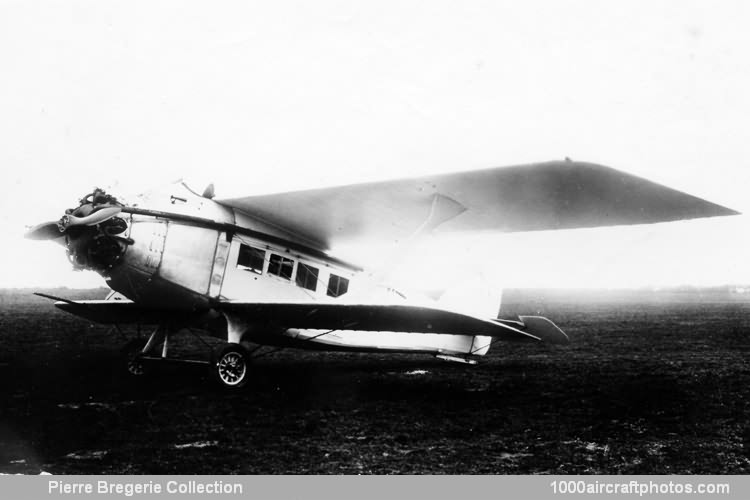
Bre 26 T (
Pierre Bregerie Collection)
The first prototype (c/n 1) made its first flight in November 1926, and was later registered F-AIIJ to its producer Société des Ateliers d'Aviation Louis Breguet at Velizy-Villacoublay, Paris, France, it subsequently went to Air Union were it was used experimentally for a short time on the Paris-Lyons-Marseilles route. It never went into line service, and the prototype was destroyed in December 1928. However, its experimental operation led to the production of the
Breguet 280 T series.
A second prototype was built and exhibited at the 1926 Paris Salon (3-19 December). Initial fitted with the Jupiter 9Ab engine, it was later fitted with a 450 hp Lorraine 12Ed Courlis twelve-cylinder liquid-cooled W-engine. It was registered F-AIJQ (c/n 2) in August 1927, it was lost in June 1928. Two 12Ed Courlis powered Bre 26 TSbis ambulance versions were built for the French AF.
Two Bre 26 Ts were built under license by Construcciones Aeronautics SA (CASA) at Getafe near Madrid, Spain. These had 450 hp Elizalde A. W engines (Lorraine 12Eb built under license by Elizalde at Barcelona), and were fitted with wings of the
Breguet Bre 19 TR Bidón, these had greater span and rounded edges.
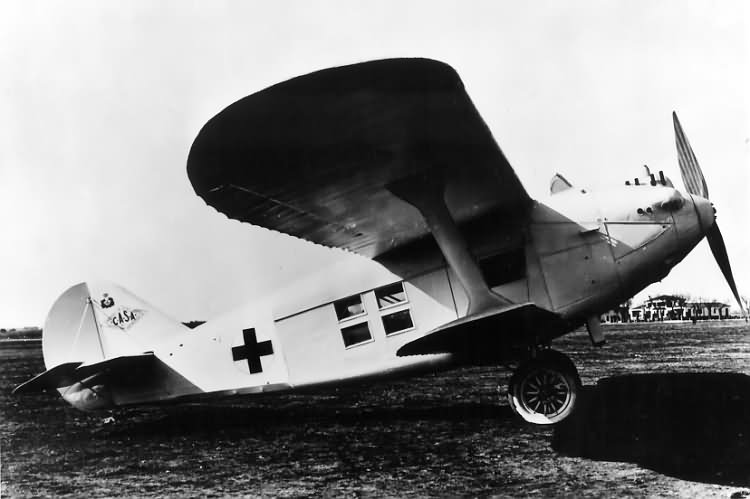
(M-CEAE) (
Nico Braas Memorial Collection)
The first CASA Bre 26 T was registered M-CEAE (c/n 113) on September 15, 1928 and delivered as an ambulance to the Spanish AF, by 1934 the registration had been cancelled. The second was registered as M-CHHA (c/n 114) on October 14, 1929, later changed to EC-HHA. It was operated by CLASSA (Concesionaria de Líneas Aéreas Subvencionadas SA, literally Subsidized Airlines Concessionaire, Inc.), later by LAPE (Líneas Aéreas Postales Españolas, Spanish Postal Airlines).
The following data is related to the Breguet Bre 26 T.
Nakajima N-36 (J-BAYO)
The aircraft above was incorrectly designated as a Breguet Bre 26 T, with thanks to Dan Shumaker, it is now correctly designated Nakajima N-36.
In the late 1920s Japan's Department of Communications sponsored a competition for 'Made in Japan' transport aircraft. Nakajima was one of the contenders and, like the others that qualified to compete, was given a grant-in-aid to design and manufacture such an aircraft. This project came under the design supervision of Kimihei Nakajima who had just returned to Japan in April 1927 from his stay in France in connection with importation of technologies and procurement of materials.
For the Nakajima entry, the Bre 26 T and Bre 280 T transports were favored for their design concepts. These aircraft were highly regarded single-engined passenger transports in France at that time. Nakajima's earlier experience with the
Breguet Bre 14 and
Bre 19 was also helpful.
Designated N-36, the single-engine biplane of unequal span had a metal construction with fabric covering. It had an open cockpit for a crew of two and a cabin for six passengers. To power the new aircraft, the license-built 450 hp Bristol Jupiter 9Ab nine-cylinder air-cooled radial engine (produced by Nakajima) was selected, it drove a two-blade wooden airscrew.
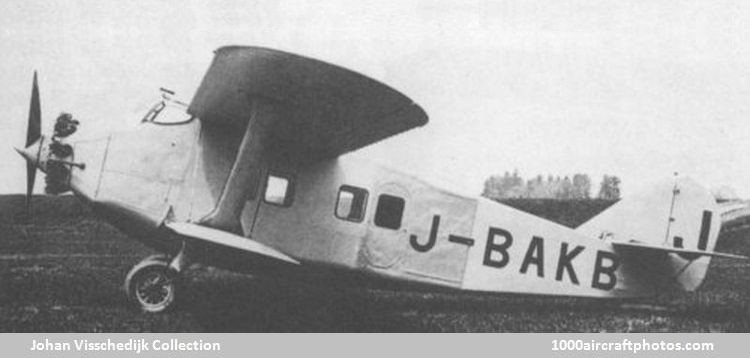
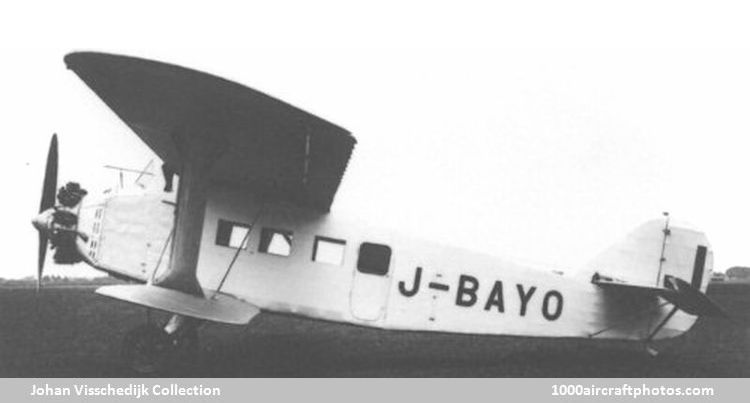
Nakajima N-36 (J-BAYO) (
Johan Visschedijk Collection)
The two examples of these aircrafts, J-BAKB (c/n 1) and J-BAYO (c/n 2), were completed in May 1928 and April 1929 and Kan-ichiro Kato took the on its first flight on 3 May, 1928, a flight which gave high expectations for the success of the new transport. On the next day a flight was made with seven mechanics to test full-cabin occupancy and to reward them for their efforts in building the aircraft. Without warning when about 328 ft (100 m) in the air after take off, the aircraft suddenly nosed over and plummeted to the ground, killing everyone on board. The cause of the accident was never fully determined.
Various modifications were made to the second aircraft, and it was used as the experimental aircraft of Nihon Koku Yuso KK at Tachikawa and Haneda Airfield, mainly as a cargo transport and crew trainer. In this service it showed that it out-performed the other contenders, the Aichi AB-1 and the Mitsubishi MC-1, as well as a
Junkers F 13 in both climb and payload, according to evaluations made by the Aviation Bureau. The Aichi entry was declared the winner, but all were deemed unsatisfactory by the Bureau because biplane designs were considered obsolete by European standards."
Created September 30, 2009