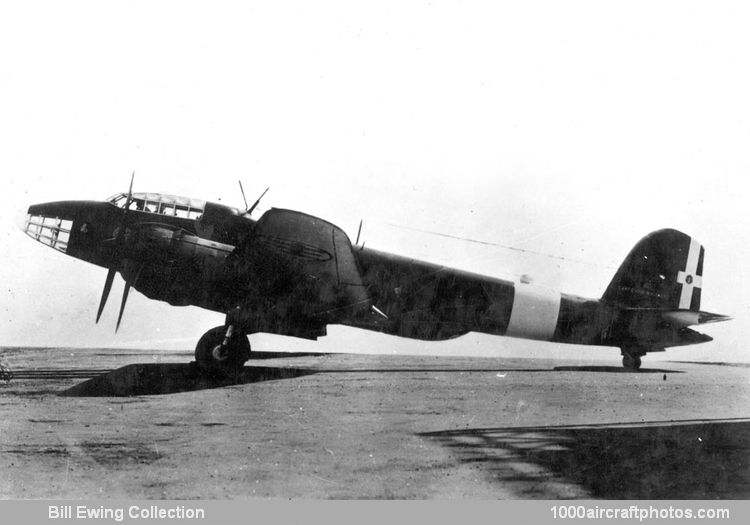
The first prototype was of wooden construction with endplate vertical tail surfaces. The second prototype was of all-metal construction and while it retained its predecessor's basic low-wing configuration with fully retractable tail wheel landing gear, it had a single vertical tail surface, a lengthened nose and the cockpit moved forward from the original position above the wing.
A total of 1,110 bombers were ordered in seven versions, but its operational debut with one Gruppo (Squadron) of the Italian Regia Aeronautica (Royal Air Force) in early 1943 was too late materially to affect the course of war. By the Italian Armistice on September 9, 1943, only 17 aircraft were produced: two prototypes, ten (wooden) pre-production aircraft (first flown December 5, 1941) and five (metal) series aircraft (first flown September 22, 1942.
After the Armistice two were still operated by the (northern) republican air force, then known as the Aeronautica Nazionale Repubblicana, others were operated with the (southern) royalist air force, known as the Aviazione Cobelligerante Italiana.
Power plants were two 1,320 hp Piaggio P.XII RC 35 or 1,350 hp Alfa Romeo 135 RC 32 Tornado air-cooled radial engines. Armament consisted of one 0.50 in (12.7 mm) machine gun each in starboard wing, dorsal turret, and ventral position, and two 0.303 in (7.7 mm) machine guns in beam positions. Maximum internal bomb load was 3,310 lb (1,500 kg)."