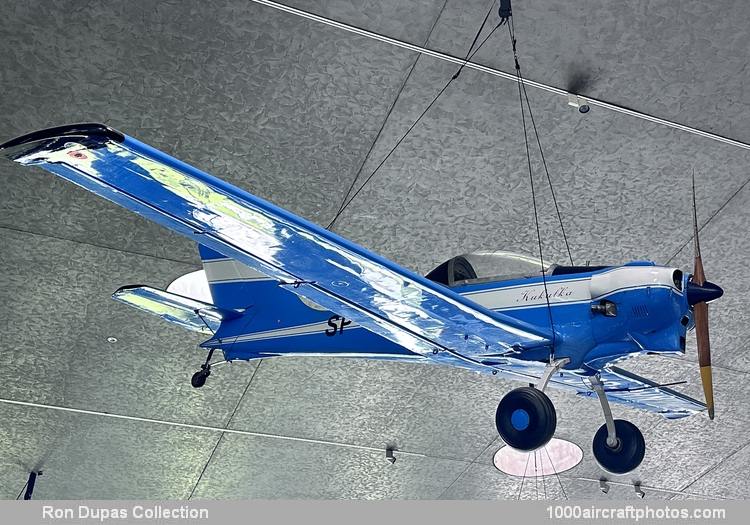
02/08/2026. Remarks by Johan Visschedijk: "Eugeniusz Pieniazek was an amateur designer. In the late 1960s, while working at the Glider Center in Leszno, he demonstrated Polish gliders in Sweden and established contacts with Swedish pilots there. Because of this, upon returning home, he began to be harassed by the Security Service, and so he decided to leave the Polish People's Republic. He had no chance of obtaining a passport and legally leaving, and he also didn't want to steal a plane from a flying club, so he decided to build his own plane to escape the country.
The general concept of the aircraft was based on the English single-seat amateur aircraft Turbulent. The aircraft was constructed using modified wings and a cockpit canopy from a crashed SZD-8 Jaskólka glider, a tail section from an SZD-24 Foka glider, a control stick from a Zefir glider, and a Continental A-65 engine and landing gear from a Piper Cub.
Construction of the aircraft took place primarily in Eugeniusz Pieniazek's apartment in an apartment building in Leszno, in an 8-square-meter room. Finished components that didn't fit in the stairwell were lowered to the ground through a window using ropes. Final assembly took place at Leszno Airport. The name Kukulka (Cuckoo) was coined by the designer's then-7-year-old daughter, Iza. The aircraft first flew in the spring of 1971 and, as the first amateur design in the Polish People's Republic, was registered with the registration number SP-PHN. For several months in 1971, Eugeniusz Pieniazek flew the Kukulka around Poland, training 44 pilots, including 5 women, including Pelagia Majewska, Maksymiliana Czmiel-Paszyc and Halina Bulka.
On the morning of September 13, 1971, Eugeniusz Pieniazek flew a Kukulka from Bielsko-Biala to Krosno. He was scheduled to return that same afternoon. After taking off for the return flight to Bielsko, he turned south after a few kilometers and, after a three-hour low-altitude flight over Czechoslovakia and Hungary in a storm and heavy rain, with the engine threatening to seize at any moment due to low oil pressure, landed in Subotica, Yugoslavia. He was reported missing in Poland.
He spent seven months in Yugoslavia in prison (during which time he mastered the Serbo-Croatian language), after which he was allowed to cross the border into Austria. From there, in May 1972, he reached Sweden, where he settled in exile and obtained Swedish citizenship (while retaining his Polish citizenship). With the help of Swedish colleagues, in 1973 he brought his wife and daughter to Sweden (to enable Pieniazek's wife to travel to Sweden, one of the Swedes married her).
In 1973, the Pieniazeks also traveled to Subotica to bring back to Sweden the Kukulka, which had been abandoned there. Initially, the Yugoslavs refused to return it, but eventually returned it after Pieniazek paid $1,200 for two years of storing the plane at their airport. (They used the money to organize a lavish drinking party.) The Pieniazeks transported the Kukulka from Yugoslavia to Sweden by towing the fuselage behind a VW Beetle, with the dismantled wings placed on the car's roof.
After being brought to Sweden, the Kukulka sat in a hangar at Eskilstuna Airport for 17 years. In 1990, it was restored to flying condition. The engine and landing gear needed to be replaced. A Continental A-90 engine and new laminate landing gear were installed. For three years, the Kukulka flew in Sweden. The engine proved faulty, and a new one had to be purchased. In 1993, Eugeniusz Pieniazek transported it to Poland. In 1996, it was re-registered in Poland with the registration number SP-FKU. Later, the original registration number SP-PHN was restored. In 2005, TVN produced a documentary series, "Great Escapes," devoted to famous escapes from the Polish People's Republic. One episode focused on Eugeniusz Pieniazek's escape in the Kukulka.
On September 13, 2005, on the 34th anniversary of the flight to Yugoslavia, Eugeniusz Pieniazek donated the Kukulka to the Polish Aviation Museum in Kraków. Due to weather conditions, the aircraft's previously planned landing on the runway at the historic Rakowice-Czyzyny Airport, where the Museum is located, prevented the aircraft from landing, so the handover ceremony took place at the Kraków Aeroclub airport in Pobiednik Wielki. On June 25, 2006, during the 3rd Malopolska Aviation Picnic, test pilot Boguslaw Mrozek ferried the aircraft to the Museum.
In the early 1990s, Eugeniusz Pieniazek founded the Experimental Aviation Association (EAA) in Poland, Branch No. 991, and began building replicas of the Bücker Bü 131 Jungmann aircraft. He was also the prime mover in the construction of a flying replica of the RWD-5 aircraft. In the early 1990s, he returned to Poland and settled near Krosno. He passed away on February 7, 2020, at the age of 86."