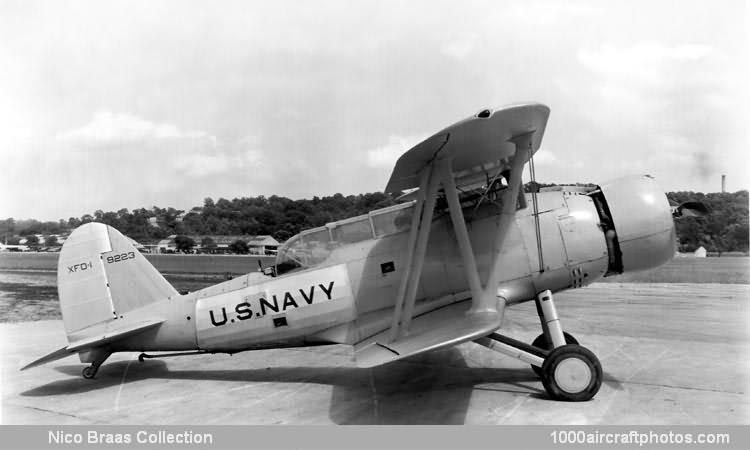
Designed under the supervision of J. Kindelberger and A. Raymond, the XFD-l was a two-seat externally-braced fabric covered metal biplane, powered by a 700 hp Pratt & Whitney R-1535-64 fourteen-cylinder air-cooled radial. Armament consisted of two forward-firing 0.30 in (7.62 mm) machine guns mounted in the engine cowling and one hand-held 0.30 in machine gun in the rear cockpit.
Completed in January 1933, the aircraft was test flown by Eddie Allen, and subsequently delivered to NAS Anacostia, for competitive trials with the Vought XF3U-1, and Service Acceptance Trials took place at NAS Anacostia between 18 June, 1933, and 14 August, 1934. Despite displaying excellent flying characteristics, the Navy had lost interest in the two-seat fighter c1ass and the XFD-l was not proceeded with, and it was returned to Douglas.
Eventually in 1936 the aircraft was fitted with a 750 hp Wright 1820-F53 nine-cylinder radial and offered for export as a two-seat scout bomber. However, the aircraft was by then obsolete as a combat aircraft and, as no customer could be found, was handed over to Pratt & Whitney to be used as an engine test bed."
Span: 31 ft 6 in (9.60 m)
Length: 25 ft 4 in (7.72 m)
Height: 11 ft 1 in (3.38 m)
Wing area: 295 sq.ft (27.69 sq.m)
Weight empty: 3,227 lb (1,464 kg)
Max take off weight: 5,000 lb (2,268 kg)
Max speed: 208 mph (335 kmh) at 8,000 ft (2,440 m)
Cruise speed: 170 mph (274 kmh)
Service ceiling: 23,700 ft (7,225 m)
Climb: to 5,000 ft (l,524 m) 3.3 min
Range: 576 miles (927 km)