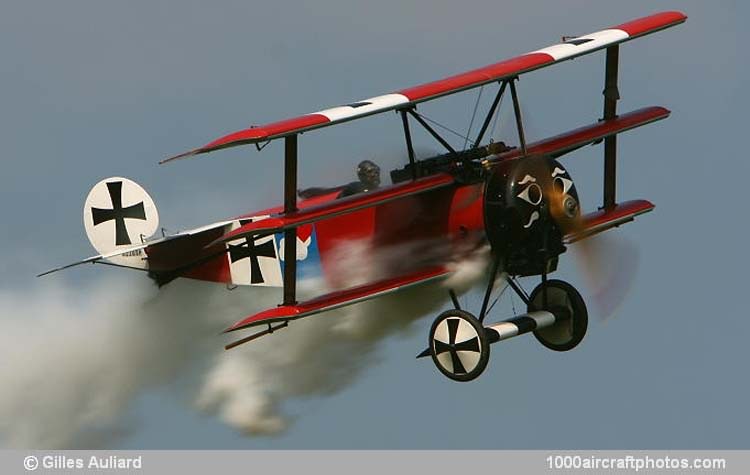
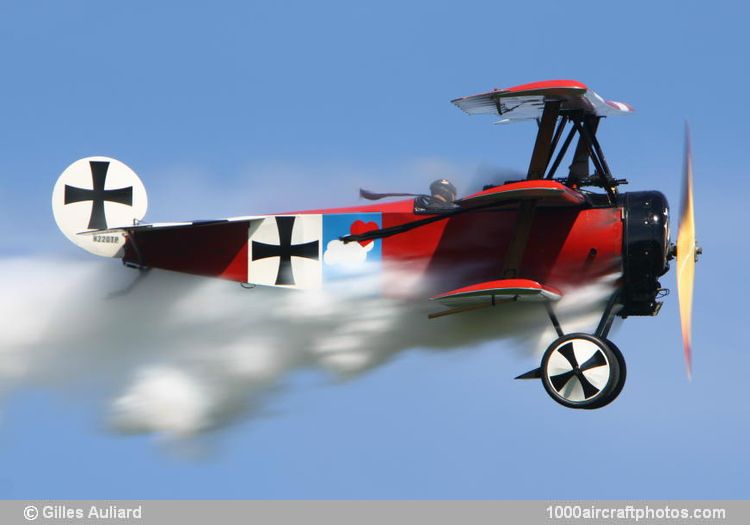
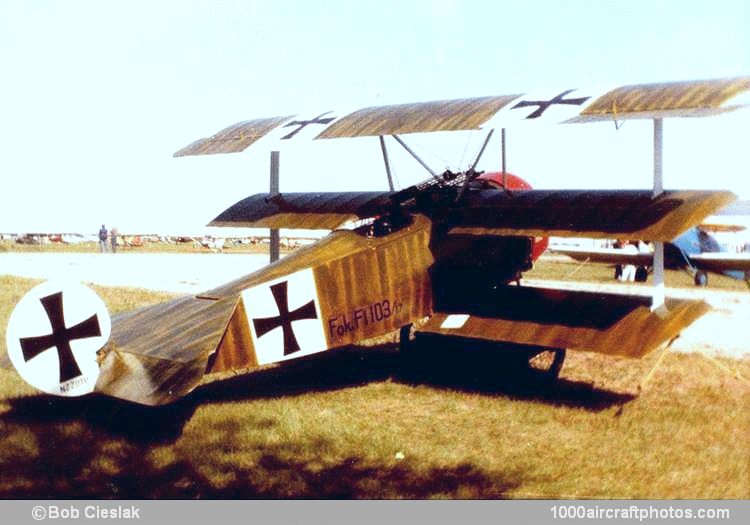
05/31/2010. Remarks by Johan Visschedijk: "The series version of the V.4 single-seat fighter triplane prototype, designated Dr.I and fitted with a 110 hp Le Rhône, began to reach the Front in October 1917. In fact the second and third series aircraft had been evaluated from the latter part of August from Courtrai by Manfred von Richthofen's Jasta. Armed with two synchronized 0.312 in (7.92 mm) LMG 08/15 machine guns, the Dr.I was powered by the 110 hp Oberursel Ur II copy of the nine-cylinder Le Rhône rotary.
The Dr.I enjoyed some success in combat, being extraordinarily maneuverable, but deliveries to the Fliegertruppen were inhibited by engine shortages and the need to replace the wings of all early production aircraft, manufacturing standards of which were considered unacceptable by the Idflieg. The original V.5 was brought up to production standards and delivered as a Dr.I, and 320 series Dr.Is were delivered to the Fliegertruppen. One was supplied to the Austro-Hungarian MAG concern.
Four prototypes with more powerful engines were completed as V.7s. One of these, with an eleven-cylinder Oberursel Ur III rotary of 145 hp, participated in the first D-type contest at Adlershof, attaining an altitude of 16,405 ft (5,000 m) in 15.5 min. Two V.7s were delivered to Austria-Hungary, one with a 160 hp Siemens & Halske Sh III rotary and the other with a 145 hp Steyr-built Le Rhône, and the fourth was fitted with a 170 hp Goebel Goe III rotary.